






































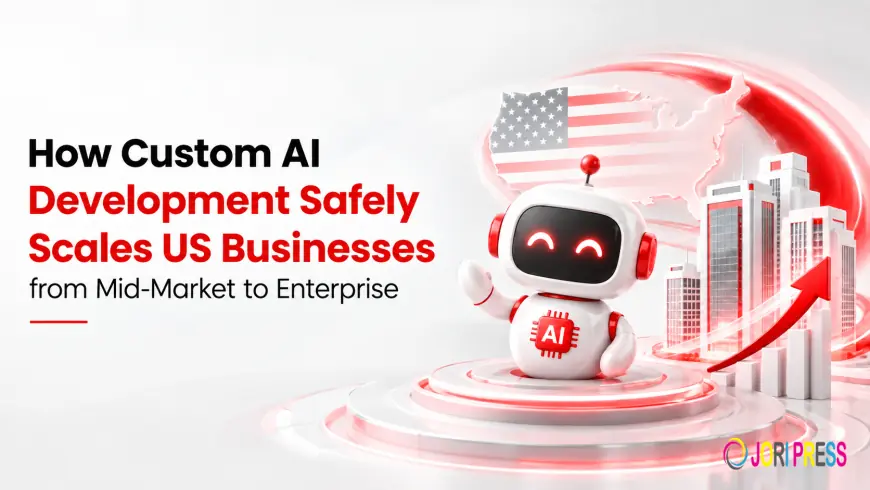
How Custom AI Development Safely Scales US Businesses from Mid-Market to Enterprise
Custom AI development helps US businesses move from mid-market operations to enterprise scale with smarter automation, data-driven decision-making, secure AI systems, and scalable workflows. Explore how the right AI strategy can support sustainable business growth while keeping security, compliance, and performance in focus.

For US businesses, AI adoption often starts with a specific operational need. A mid-market company may use AI to automate customer support, improve sales forecasting, analyze business data, streamline internal workflows, or assist employees with routine tasks. As the company grows, these individual applications may need to support more employees, customers, departments, and business processes across its US operations.
Moving from a focused AI application to enterprise-wide adoption requires more than adding new features. US businesses need technology that can work with their existing enterprise software, protect business and customer data, support growing workloads, and fit their internal governance requirements. A custom AI solution developed with the support of an AI development company can provide the flexibility needed to build around these requirements instead of forcing the business to change its operations around a generic AI platform.
Why US Mid-Market Businesses Need a Scalable AI Strategy
US mid-market companies often have established CRM, ERP, financial, customer service, and workforce systems. They may also have multiple teams using different applications to manage daily operations. Introducing AI into this environment requires careful integration so that the technology supports existing workflows rather than creating another isolated system.
Custom AI development allows a US business to begin with a specific use case and create a foundation for future expansion. For example, a company could start with an AI customer-support assistant and later connect the same broader AI environment with sales, internal knowledge management, analytics, or operational workflows. This phased approach allows businesses to expand AI based on actual operational requirements.
Build AI Architecture for Growing US Operations
As a US company expands, its AI applications may need to serve more employees, customers, locations, and business processes. The underlying architecture needs to accommodate increased data volumes and workloads without creating unnecessary disruption to existing systems. Separating application services, AI models, data processing, storage, and integration layers can make individual components easier to expand and manage.
An AI development company can assess a business's existing technology environment and plan how AI applications should connect with enterprise systems. APIs, cloud infrastructure, databases, model-serving systems, monitoring tools, and automated deployment processes can be incorporated according to the company's requirements. This creates a technical foundation that can support the transition from a single AI project to broader enterprise adoption across US operations.
Protect Customer and Business Data as AI Adoption Grows
Data protection becomes increasingly important as AI moves deeper into US business operations. A company may initially use a limited internal dataset, but enterprise adoption can involve customer records, employee information, financial information, proprietary documents, and operational data from multiple systems. Giving AI applications broader access without appropriate controls can create unnecessary security and governance risks.
Custom AI development can incorporate authentication, role-based access, encryption, audit logging, controlled data pipelines, and permission management into the application. US businesses should also review the legal and regulatory requirements that apply to their specific industry, customer base, and data practices. Building these considerations into the AI architecture from the beginning can make future expansion more manageable.
Expand AI Across US Departments Without Creating Silos
A US business does not need to introduce AI across every department simultaneously. A more structured approach is to begin with a clearly defined business process, measure its results, and then extend AI capabilities to additional areas. Sales teams may require intelligent lead analysis, customer service may need AI-assisted support, finance teams may use predictive analytics, and operations teams may benefit from workflow automation.
As more departments adopt AI, organizations need consistent standards for access, data usage, model management, monitoring, and human oversight. A centralized approach can help prevent every department from selecting unrelated AI tools that cannot communicate with one another. This gives US companies a clearer path to building an enterprise AI environment while allowing individual teams to address their own operational requirements.
Maintain AI Security and Performance as the Business Scales
AI systems serving a growing US customer base or workforce require continuous monitoring. Increased usage can affect application performance, infrastructure requirements, model response times, and operating costs. Businesses should track system availability, application errors, AI output quality, resource usage, and other relevant performance indicators as adoption increases.
Security also needs continuous attention. Employee access may change, new integrations may be introduced, and AI models or application components may require updates. Controlled deployment processes, regular access reviews, security testing, monitoring, and maintenance can help businesses manage these changes. An AI development company can support the technical side of these activities while internal teams maintain oversight of business policies and operational requirements.
Create a Roadmap From Mid-Market AI to Enterprise Adoption
For US executives, scaling AI should be treated as a phased business initiative rather than a single technology purchase. The first stage can focus on identifying a specific business problem and establishing measurable objectives. Once the initial solution demonstrates its usefulness, the company can determine which additional workflows, departments, and systems should be brought into the AI strategy.
This roadmap should also define who owns the AI applications, data, security processes, performance monitoring, and future development. Working with an AI development company can give US businesses access to specialized technical resources for architecture, integrations, development, testing, deployment, and ongoing improvements. This allows companies to expand their AI capabilities while keeping the broader business strategy in view.
Move Your US Business From AI Adoption to Enterprise Scale
For US mid-market companies, the move toward enterprise AI is a gradual process that combines technology, data, security, and business planning. Custom AI development can provide the flexibility to build around existing systems while creating room for additional users, workflows, integrations, and applications as the company grows.
If your US business is ready to move beyond individual AI experiments, the next step is to define which business processes should be prioritized and what technical foundation is required to support future expansion. Connect with an AI development company to discuss your business requirements, evaluate the right AI architecture, and create a practical roadmap for scaling AI across your US operations.
What's Your Reaction?
 Like
0
Like
0
 Dislike
0
Dislike
0
 Love
0
Love
0
 Funny
0
Funny
0
 Angry
0
Angry
0
 Sad
0
Sad
0
 Wow
0
Wow
0