






































How Can Generative AI Solve Data Overload and Improve Business Decision-Making?
Discover how generative AI helps businesses turn overwhelming data into actionable insights and make faster, more informed decisions.

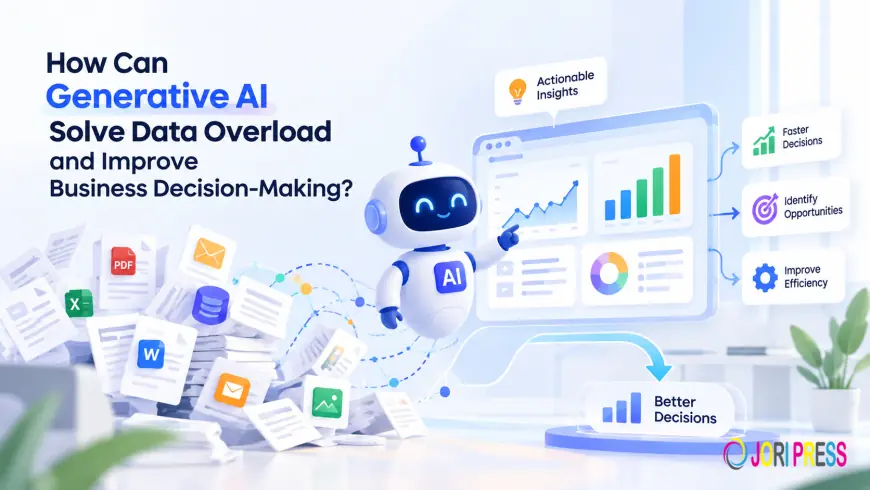
Businesses collect data from almost everything they do. Sales teams track customer interactions, marketing teams monitor campaign performance, and finance teams manage invoices, expenses, and reports. The problem is that having more data does not automatically lead to better decisions.
I've seen why this creates a challenge for growing businesses: teams spend too much time finding information, preparing reports, and trying to understand what the numbers actually mean. By the time they identify a useful insight, the opportunity to act on it may have already passed.
Generative AI offers a practical way to address this problem. With the right implementation, businesses can summarize large volumes of information, identify patterns, ask questions in natural language, and turn complex reports into useful recommendations.
How Can Generative AI Solve Data Overload?
Generative AI helps businesses manage data overload by summarizing documents, extracting relevant information, answering questions about business data, and presenting findings in clear language. Instead of manually reviewing multiple reports, employees can use AI-powered tools to find relevant insights and make more informed decisions.
However, AI should support decision-making rather than automatically replace human judgment. The quality of its recommendations depends on the accuracy of the underlying data, the system's design, and appropriate validation.
Why Does Data Overload Make Business Decisions Difficult?
The challenge is not always a lack of information. Often, it is the difficulty of connecting information from different sources.
Consider an e-commerce business that experiences declining sales. Its sales dashboard shows the decline, customer support records contain complaints about delivery delays, and inventory reports reveal that popular products are frequently unavailable.
Each system contains part of the answer. Someone must connect those details to understand the underlying problem.
Common challenges include:
-
Scattered information: Business data sits across spreadsheets, CRM systems, databases, emails, and documents.
-
Time-consuming reporting: Employees spend hours collecting, cleaning, and summarizing information.
-
Missed connections: Important relationships between customer behavior, operational issues, and financial performance can go unnoticed.
-
Delayed decisions: Managers wait for reports instead of responding when a problem first appears.
-
Information overload: Large reports make it difficult to identify which findings deserve immediate attention.
Generative AI can help bring relevant information together, making it easier for decision-makers to focus on what matters.
5 Ways Generative AI Improves Business Decision-Making
1. Summarizing Large Volumes of Business Information
Reading lengthy reports, customer feedback, contracts, and internal documents can consume valuable working hours.
Generative AI can summarize these materials into key findings, recurring concerns, risks, and recommended follow-up questions. For example, a customer experience manager could review a summary of support conversations to identify repeated complaints about a product feature.
The important detail is that summaries should preserve context and link back to original records whenever possible. This allows employees to verify important findings instead of relying entirely on an AI-generated explanation.
2. Connecting Information Across Different Systems
Businesses often store related information in separate platforms. A sales report alone may not explain why revenue has fallen, but combining it with inventory, customer feedback, and marketing data can provide a clearer picture.
A custom generative AI solution can retrieve relevant information from connected business systems and explain potential relationships.
For instance, a retail manager could ask, "Why did sales decline for our most popular products last month?" The system could examine authorized sales and inventory records, identify stock shortages, and highlight the periods that require further investigation.
This works best when the underlying data is accessible, consistent, and properly integrated.
3. Enabling Natural-Language Questions
Traditional analytics tools often require users to understand dashboards, filters, or query languages. Generative AI can make business information easier to explore through everyday questions.
Employees might ask:
-
Which products generated the most revenue last quarter?
-
What are the most common reasons for customer complaints?
-
Which pending orders require attention?
-
What changed between this month's expenses and last month's?
A well-designed system can translate these questions into appropriate data retrieval or analysis operations and explain the results in plain English.
For financial or operational decisions, it should also display the reporting period, relevant assumptions, and supporting data so users can verify the answer.
4. Identifying Trends and Potential Risks
Generative AI can help explain patterns found in reports and analytical outputs. It may highlight recurring customer concerns, unusual expense categories, or changes in product demand.
For example, a subscription business might notice that cancellation requests frequently mention onboarding difficulties. AI can group similar feedback and summarize the issues for the product team.
However, generative AI does not automatically provide reliable forecasting simply because it can analyze text. Predictive tasks may require statistical models, machine learning, or dedicated forecasting tools, with generative AI helping explain the results.
5. Turning Insights Into Actionable Reports
Identifying a problem is only part of the process. Teams also need to communicate findings and decide what to do next.
Generative AI can convert verified findings into management summaries, meeting briefs, comparison reports, and draft action plans.
A report might highlight a decline in repeat purchases, summarize the customer feedback associated with it, and suggest investigating delivery experience or product quality.
These recommendations should be treated as hypotheses to evaluate, not guaranteed solutions. Human review remains important, especially when decisions involve budgets, customers, or business risk.
How Does Custom Generative AI Development Work?
Generic AI tools can be useful for everyday tasks, but businesses with specialized workflows or sensitive information may need a tailored solution.
A Generative AI Development Company can help design a system around specific business requirements, data sources, permissions, and decision-making processes.
A practical implementation typically follows these steps:
-
Identify the business problem: Choose a clear use case, such as reducing the time required to prepare weekly management reports.
-
Assess data readiness: Review data quality, formats, access permissions, and inconsistencies.
-
Connect relevant sources: Integrate approved databases, documents, CRM platforms, or business applications.
-
Select the appropriate architecture: Use retrieval-augmented generation (RAG), suitable AI models, structured data queries, or a combination where appropriate.
-
Test with real scenarios: Compare AI-generated answers with verified records and evaluate accuracy, relevance, and consistency.
-
Deploy with safeguards: Introduce access controls, logging, human review, and monitoring for incorrect or unsupported answers.
-
Measure business outcomes: Track whether the system reduces reporting time, improves information retrieval, or helps teams resolve issues more efficiently.
For example, a company could begin with an internal knowledge assistant that answers employee questions using approved documents. Once its reliability is established, the business could expand into more complex reporting workflows.
What Should Businesses Consider Before Adopting Generative AI?
A successful implementation requires more than selecting an AI model.
Data security: Sensitive customer, financial, and employee information must be protected through appropriate access controls and data-handling policies.
Accuracy: AI-generated answers can contain errors. Important findings should be traceable to reliable records and independently verified.
Integration: The solution must work with existing systems rather than creating another isolated information source.
Cost and scalability: Model usage, infrastructure, integration, maintenance, and monitoring all contribute to the total cost of ownership.
Measurable outcomes: Define what success means before deployment, whether that is faster reporting, fewer manual steps, or improved access to business information.
These considerations help businesses avoid investing in an AI system that looks impressive but fails to solve a meaningful operational problem.
How Can CryptoApe Help With Generative AI Development?
If your business struggles with disconnected data, repetitive reporting, or time-consuming information searches, a tailored AI solution may help simplify those workflows.
CryptoApe can help businesses explore generative AI development based on their operational needs, data environment, and intended outcomes. The right starting point is not necessarily the most complex AI application; it is the specific problem that creates the greatest friction for your team.
Explore our Generative AI Development Company page to discuss potential solutions for your business.
Conclusion
Data overload becomes a business problem when employees spend more time finding information than using it. Generative AI can help bridge that gap by summarizing documents, connecting relevant information, answering business questions, and explaining analytical findings.
The key is to start with a specific problem, establish reliable data access, and validate the results before expanding the solution.
Ready to turn your business data into actionable insights? Contact CryptoApe to explore a generative AI solution aligned with your business goals.
What's Your Reaction?
 Like
0
 Dislike
0
 Love
0
 Funny
0
 Angry
0
 Sad
0
 Wow
0