


































Handling Out-of-Scope Queries in Intent Classification Systems
Discover how to handle out-of-scope queries in intent classification using quality text annotation, OOS datasets, and effective detection strategies.
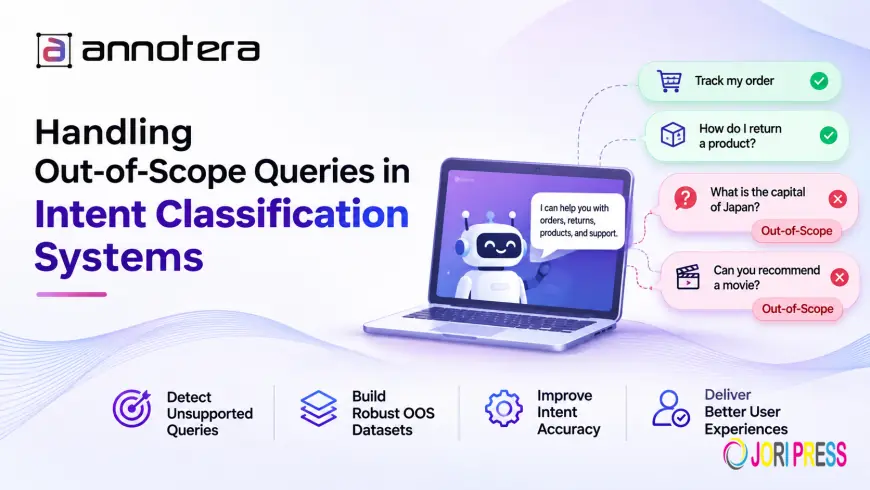
Conversational AI systems, chatbots, and virtual assistants are designed to understand user requests and respond with relevant information. However, not every query received by these systems falls within their intended capabilities. Users may ask unrelated questions, submit ambiguous requests, switch topics unexpectedly, or request services that the system is not designed to handle. These interactions are known as out-of-scope (OOS) queries.
Handling such queries effectively is essential for building reliable conversational AI applications. Without proper detection mechanisms, an AI model may assign incorrect intent labels, generate irrelevant responses, or provide misleading information. This is where well-structured intent classification systems and high-quality training datasets become particularly important.
By combining accurate text annotation, clearly defined intent taxonomies, and out-of-scope detection strategies, businesses can improve chatbot reliability and user experience. In this article, we explore how AI teams can identify, classify, and manage out-of-scope queries while maintaining the accuracy of conversational systems.
What Are Out-of-Scope Queries in Intent Classification?
Out-of-scope queries are user inputs that do not match any predefined intent or fall outside the functional boundaries of an AI application.
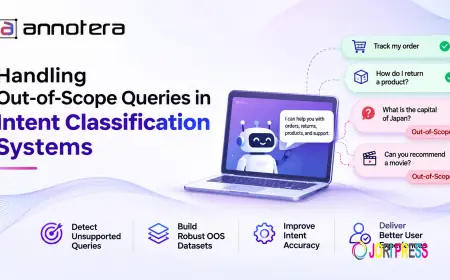
For example, consider an e-commerce chatbot designed to handle product searches, order tracking, payment assistance, and return requests. If a user asks, "What is the capital of Japan?" the chatbot receives a question unrelated to its intended functions.
Similarly, a banking chatbot may encounter questions about entertainment, general knowledge, or services that are not supported by its current functionality.
These queries can generally be categorized into three types:
-
Unrelated queries: Questions that have no connection to the application's purpose.
-
Unsupported requests: Queries related to the domain but involving services or functionalities the chatbot cannot perform.
-
Ambiguous queries: Inputs that lack sufficient context or clarity to assign a reliable intent.
Distinguishing between these categories helps AI systems avoid incorrect predictions and respond appropriately.
Why Handling Out-of-Scope Queries Matters
An intent classification model is only effective when it can distinguish between supported requests and inputs that fall outside its predefined categories.
Poor out-of-scope detection can create several challenges:
1. Incorrect Intent Predictions
When an unfamiliar query is forced into an existing intent category, the model may generate an incorrect classification. This can trigger irrelevant responses and disrupt the conversation.
2. Reduced User Satisfaction
Users expect conversational AI systems to recognize their limitations. Repeatedly receiving unrelated answers can reduce trust and encourage users to abandon the application.
3. Increased Operational Costs
Incorrect classifications may trigger unnecessary human intervention, additional customer support requests, and repeated interactions.
4. Model Performance Degradation
If out-of-scope examples are missing from training datasets, models may struggle when exposed to unfamiliar language patterns or unexpected user requests.
Addressing these challenges requires a systematic approach to dataset development, annotation, and model evaluation.
Key Strategies for Detecting Out-of-Scope Queries
Developing reliable OOS detection capabilities involves more than introducing a single rejection label. AI teams must establish consistent classification rules and train models to recognize different types of unsupported inputs.
1. Establish a Dedicated Out-of-Scope Intent Category
One of the most effective approaches is creating a dedicated OOS category within the intent taxonomy.
Instead of forcing every incoming query into an existing intent, the model learns to recognize inputs that do not belong to any supported category.
For example, a healthcare appointment chatbot might include intents such as appointment booking, appointment cancellation, and doctor availability. Questions about movie recommendations should be classified as out-of-scope rather than assigned to an unrelated healthcare intent.
A clearly defined OOS category provides a structured foundation for handling unsupported interactions.
2. Build Diverse Out-of-Scope Training Datasets
OOS queries can vary significantly in wording, complexity, and context. Training datasets should therefore include diverse examples representing different types of unsupported requests.
These may include:
-
General knowledge questions.
-
Unrelated product or service inquiries.
-
Requests for unavailable chatbot functionalities.
-
Incomplete or unintelligible messages.
-
Unexpected topic changes during conversations.
-
Queries containing unfamiliar terminology.
A diverse dataset helps models recognize unfamiliar inputs instead of memorizing a limited collection of examples.
3. Apply Context-Aware Text Annotation
Not every unfamiliar query is necessarily out-of-scope. A user may express a supported intent using different terminology, incomplete sentences, or conversational language.
For instance, "Where's my package?" and "Can you tell me when my delivery arrives?" may represent the same order-tracking intent.
Annotators must understand the surrounding context before assigning labels. Context-aware annotation helps distinguish legitimate variations of supported intents from genuinely unrelated requests.
This process is especially important when developing multilingual conversational AI systems.
4. Define Clear Annotation Guidelines
Inconsistent labeling can negatively affect model performance. Annotation teams should follow standardized guidelines that explain when a query should receive an existing intent label, an OOS label, or an ambiguous-input label.
Guidelines should include:
-
Definitions of supported and unsupported intents.
-
Examples of borderline queries.
-
Rules for handling incomplete sentences.
-
Instructions for multi-intent and context-dependent inputs.
-
Escalation procedures for uncertain cases.
Regular annotation reviews and inter-annotator agreement assessments can further improve labeling consistency.
The Role of Text Annotation Outsourcing Services
Large-scale conversational AI projects often require thousands or millions of labeled text samples. Managing these datasets internally can become challenging, particularly when projects involve multiple languages, complex intent taxonomies, and strict quality requirements.
Partnering with professional text annotation outsourcing services can help AI developers manage these requirements more efficiently.
An experienced text annotation company can support the development of structured training datasets through:
Domain-Specific Annotation: Human annotators understand project requirements and classify supported, ambiguous, and out-of-scope queries according to predefined guidelines.
Quality Assurance: Multi-level review processes help identify inconsistent labels, incorrect classifications, and annotation gaps.
Dataset Expansion: Annotation teams can continuously introduce diverse OOS examples to improve model exposure to unfamiliar queries.
Scalable Workflows: Outsourcing partners can support large annotation volumes while maintaining standardized labeling procedures.
At Annotera, we recognize that reliable conversational AI depends on accurate and consistent training data. Our text annotation capabilities support AI teams in developing structured datasets for intent recognition, text classification, and other natural language processing applications.
Evaluating Out-of-Scope Detection Performance
After developing an OOS detection dataset, AI teams must evaluate how effectively their models identify unsupported queries.
Several metrics can help measure performance:
-
Precision: Measures how many queries predicted as out-of-scope are genuinely out-of-scope.
-
Recall: Measures how many actual out-of-scope queries the model successfully identifies.
-
F1-Score: Balances precision and recall to provide an overall performance measure.
-
Confusion Matrix: Highlights classification errors between supported intents and the OOS category.
Teams should also conduct testing with unseen queries, paraphrased inputs, and real-world conversational examples. This helps determine whether the model can generalize beyond its training dataset.
Additionally, monitoring production interactions can reveal emerging query patterns that were not represented during initial training.
Best Practices for Improving Out-of-Scope Handling
To strengthen OOS detection, AI teams should adopt a continuous improvement strategy.
First, regularly update training datasets with newly observed unsupported queries. Second, establish confidence thresholds that allow models to reject uncertain predictions rather than making unreliable classifications. Third, design fallback responses that politely explain system limitations and guide users toward supported functionalities.
Human review is equally important. Uncertain predictions can be routed to human agents or annotation specialists, allowing organizations to identify classification gaps and improve future training datasets.
Combining automated detection, human oversight, and ongoing dataset refinement creates more dependable conversational AI systems.
Conclusion
Handling out-of-scope queries is a fundamental requirement for building reliable conversational AI applications. By establishing dedicated OOS categories, developing diverse training datasets, applying context-aware annotation, and continuously evaluating model performance, organizations can reduce classification errors and improve chatbot experiences.
High-quality text annotation remains central to this process. With the support of professional annotation workflows, AI developers can build more robust intent classification models capable of recognizing both expected and unexpected user requests.
Looking to improve your conversational AI training datasets?
Partner with Annotera for reliable text annotation solutions that support intent classification, text understanding, and scalable AI development. Visit Annotera to explore our data annotation capabilities and strengthen the quality of your AI training data.
What's Your Reaction?
 Like
0
 Dislike
0
 Love
0
 Funny
0
 Angry
0
 Sad
0
 Wow
0