










































Difference Between a 36-Page and 60-Page Passport
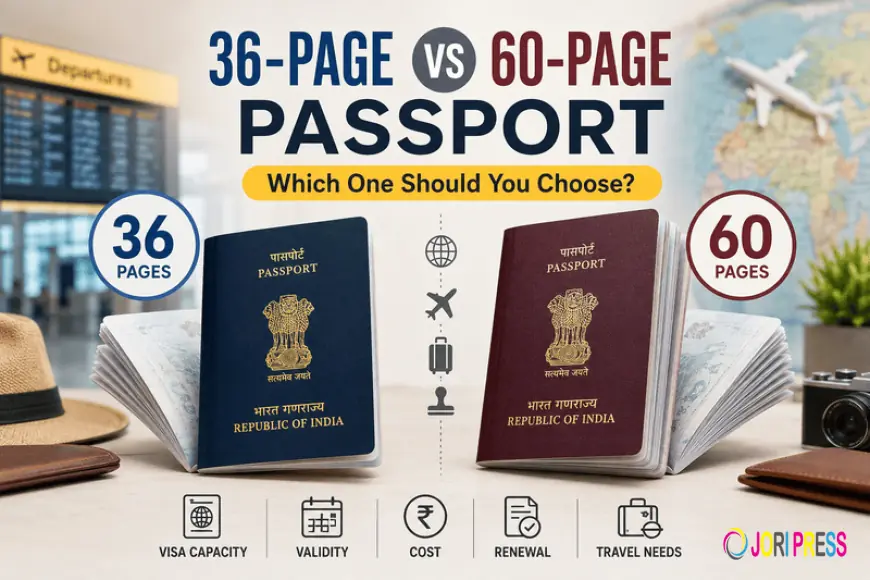
Are you confused about whether to apply for a 36-page passport or a 60-page passport? Choosing between them usually depends on how much you travel outside the country's borders. You can opt for a 36-page passport if you travel once or twice a year internationally. But if you are planning frequent international trips within a year, then a 60-page passport is more effective for your needs.
Read the blog below to understand the basic differences between a 36-page passport and a 60-page passport and how both of them are used.
When to opt for a 36-page Passport?
Individuals can choose a 36-page passport if they plan international travel occasionally. It is a cost-effective and practical Passport option for individuals looking to save money. A 36-page passport eliminates the need for a larger passport booklet by giving sufficient visa and immigration stamping pages.
The individuals who can decide on a 36-page passport include:
- Occasional travellers who travel internationally once or twice a year for leisure, family trips, or business travel.
- An individual who is travelling internationally for the first time can opt for the 36-page passport, which is an affordable option without the extra bulk of unused pages.
- Applicants who are on a tight budget can get the 36-page passport at a cost-effective price, which is only INR 500 less expensive than the 60-page passport.
- This type of passport is an ideal choice for visitors who plan to explore visa-free or visa-on-arrival destinations. Physical stamps are minimal or not necessary.
- The 36-page passport provides sufficient space for visa and immigration stamping for applicants with a temporary travel schedule.
When to opt for a 60-page Passport?
This is also referred to as the Jumbo passport since it is mostly used by individuals who are frequent international travellers. This passport helps the individual to avoid running out of space by providing extra pages for visa and immigration stamping.
The individuals who can decide on a 60-page passport include:
- Regular travellers can reduce the need for frequent passport issues with the additional pages in the 60-page passport.
- Business professionals like corporate executives, consultants or sales executives who need multiple visas and entry stamps can use the large passport booklet with extra pages.
- It is also suitable for students studying abroad for an extended duration. It provides enough room for the paperwork required for their entire academic career.
- Experts who are operating in several parts of the world for their work tenure or with multinational companies can opt for the 60-page passport.
- Countries such as China, Russia and the United States often issue visas that take up an entire passport page. A 60-page passport is very helpful in such cases.
What is the difference between a 36-page and a 60-page passport?
Both the 36-page passport and the 60-page passport are issued by the Government of India and serve the same purpose, but there are still a few differences between the two.
The table below outlines these differences clearly.
| Feature | 36-page Passport | 60-page Passport |
| Ideal For | Occasional travellers | Frequent international travellers |
| Visa Page Capacity | Limited | Higher Capacity |
| Total pages | 36 | 60 |
| Total number of usable visa pages | 33 | 57 |
| Validity | 10 years for adults, 5 years for minors below 18 years | 10 years for adults, 5 years for minors below 18 years |
| Reissue Frequency | May require an early reissue | Less frequent reissue |
| Normal Processing Cost | Rs. 1500 | Rs. 2000 |
| Tatkaal Processing Cost | Rs. 3500 | Rs. 4000 |
What are the steps to apply for an Indian passport?
The process to apply for an Indian passport is quite easy and direct. The only difference would be the type of booklet you would choose in the application.
You can follow the steps below to apply for an Indian passport.
1. Sign up on the Passport Seva Portal
- You must first create an account (if you have not already registered) by visiting the official Passport Seva website. The rest of the process is free.
2. Fill in the Passport Application Form
-
After registering, you can now log in using your credentials.
- You must then fill out the passport application form in detail by giving your correct personal, contact and address details.
3. Choose your Booklet Type
- The passport will be available in two options, a 36-page one and a 60-page one.
- Choose the passport type depending on your requirements. Through this, you will be deciding how many pages you will have in your passport booklet.
4. Follow the requirements and provide the necessary documents
- Attach a scanned copy of the required documents, like an Aadhaar card, address proof and date of birth.
- A birth certificate is required in case of minors.
5. Pay the Applicable Fees
- You can pay the required fees through NetBanking, credit/debit card or manually at the Passport Seva Kendra (PSK).
- The fees will be based on your choice of passport booklet and the processing speed (normal vs Tatkaal passport).
6. Make an Appointment at the Local PSK or POPSK
- You can visit your nearest PSK or POPSK to book your facility availability date.
- This is done to verify the documents and get your biometric data.
7. Go to the Appointment
- Visit the reserved centre on your booked date with your original documents.
- The authorities will check your documents, and your fingerprints, signature and photograph will be taken.
8. Track the status and get your Passport
- You can check your passport application status through SMS or by visiting the Passport Seva portal.
- You can use this to keep yourself updated on reception and dispatch information processing.
- After processing, your passport document will be sent to your registered address through speed post.
What are the renewal and replacement costs for different passport types?
The price for renewal or replacement is also different for both the 36-page and 60-page passports. It differs based on the type of passport.
1. Renewal of Expired Passports
You should renew your passport if it has expired or is close to expiry. The prices vary according to the type of booklet.
- The renewal for a 36-page passport costs Rs. 1500 (approx)
- The renewal for a 60-page passport costs Rs. 2000 (approx)
2. Reissue or Repair Fees
If your passport is damaged in any manner (such as torn pages), then you must have it replaced. The cancellation charges are as follows:
- Rs. 3000 for a 36-page passport
- Rs. 3500 for a 60-page passport
3. Replacement Fees for Lost Passports
If your passport is lost by any chance, then you must first report it to the police. Afterwards, you can apply for a replacement. The replacement prices are listed below.
- Rs. 3000 for a 36-page passport
- Rs. 3500 for a 60-page passport
4. ECR (Emigration Check Required) Deletion Charges
If you want to get the ECR status removed from your passport, then the fees for the same will be as follows.
- Rs. 1500 for a 36-page passport
- Rs. 2000 for a 60-page passport
Conclusion
Both the 36-page and 60-page passports serve the same purpose and offer the same validity and security features. The main difference is the number of pages available for visas and immigration stamps. A 36-page passport is useful for regular travellers or for those who have limited travel needs. The 60-page passport is ideal for frequent travellers and business professionals travelling abroad. Choosing the correct passport is entirely up to your requirements and how frequently you travel.
What's Your Reaction?
 Like
0
Like
0
 Dislike
0
Dislike
0
 Love
0
Love
0
 Funny
0
Funny
0
 Angry
0
Angry
0
 Sad
0
Sad
0
 Wow
0
Wow
0