


































Custom Delivery App Development for Scalable Business Growth
The development of a customized delivery application enables businesses to oversee their orders, monitor the status of deliveries, handle drivers, make financial transactions and communicate updates in real time. CodeRegime Technologies offers customized delivery application solutions, capable of route planning, and management of orders and deliveries in order to smoothen operational processes and enhance user experience.

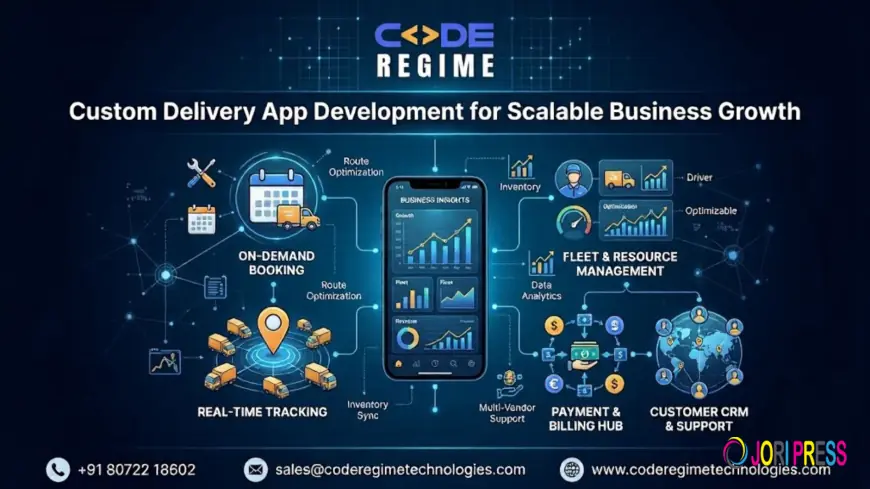
Introduction
The growing demand for convenient delivery services has created new opportunities for businesses across different industries. Customers increasingly expect to order products online and receive them at their preferred location without unnecessary delays. For businesses looking to meet these expectations, custom delivery app development can provide a practical way to manage orders, coordinate deliveries, and improve the customer experience.
Whether a company delivers food, groceries, medicines, retail products, or business supplies, a dedicated delivery application can simplify several daily operations. Instead of managing orders through phone calls, messages, and spreadsheets, businesses can use a digital platform to organize the entire delivery process.
A well-planned delivery app can help businesses serve more customers, improve communication, and prepare their operations for future growth. By choosing features that match their business requirements, companies can create a delivery solution that supports their services and long-term goals.
What Is Delivery App Development?
Delivery app development is the process of designing and building a mobile or web application that helps businesses manage orders and deliver products to customers. It can include several stages, such as requirement planning, UI/UX design, application development, API integration, testing, deployment, and ongoing maintenance.
A custom delivery application is developed around the specific needs of a business rather than relying entirely on a ready-made platform. Depending on the business model, it may include customer registration, product listings, order placement, online payments, delivery assignment, live tracking, notifications, and delivery status updates.
A delivery platform may also include separate interfaces for customers, delivery partners, and administrators. These interfaces help each user complete their tasks while allowing the business to monitor and manage the overall delivery process.
Features Designed Around Business Needs
Every delivery business operates differently. A food delivery company may need restaurant menus and order preparation updates, while a grocery delivery business may require inventory management and product substitutions.
Custom Delivery App Development allows businesses to select features based on their daily operations. Common options include product browsing, shopping carts, order history, address management, delivery scheduling, payment integration, and customer support.
Businesses can also introduce features such as discount codes, multiple delivery options, special instructions, and repeat ordering when these functions suit their customers.
By focusing on relevant features, companies can build an application that is easier to manage and more useful for their target audience.
Better Customer Experience
Customers expect a delivery application to be simple and convenient. They should be able to find products, place orders, select delivery details, and complete payments without facing unnecessary steps.
A well-designed interface can make these actions easier. Clear product information, straightforward navigation, accurate order summaries, and convenient payment options can help customers complete their purchases with confidence.
The application can also allow users to save delivery addresses, view previous orders, and repeat regular purchases. These features can save time for customers and make the ordering process more convenient.
When businesses focus on usability, they can provide a smoother experience from the moment a customer opens the app until the order arrives.
Real-Time Order and Delivery Tracking
Order tracking is a useful feature for businesses that want to keep customers informed throughout the delivery process. It can display updates such as order confirmation, preparation, dispatch, and delivery completion.
Depending on the business requirements, a delivery application can also integrate location services to show the delivery partner's position while an order is in transit.
These updates help customers understand the progress of their orders and reduce the need to contact customer support for routine information.
For businesses, tracking features can improve coordination between administrators, delivery partners, and customers. Accurate tracking depends on suitable technical integrations and reliable status updates from the people or systems handling each delivery.
Efficient Delivery Partner Management
Managing delivery partners becomes more challenging as order volumes increase. A custom delivery app can provide a dedicated interface where delivery personnel receive assigned orders, view delivery addresses, and update job statuses.
Depending on the platform, businesses may also manage partner availability, delivery schedules, service areas, and completed assignments through an administrative dashboard.
These tools can help businesses organize delivery activities and identify operational issues more easily. For example, managers can review delayed orders or check whether delivery assignments need to be adjusted.
A clear workflow can reduce confusion and help delivery teams complete their responsibilities more efficiently.
Secure Payments and Order Management
A delivery application may support several payment methods based on the target market and business model. These can include online payment gateways, digital wallets, cards, or cash on delivery where appropriate.
The app can also provide order summaries, transaction records, invoices, and refund management features if required. Integrating a suitable payment provider can make checkout more convenient while helping businesses maintain organized payment records.
Security should be considered throughout the development process. Appropriate authentication, access controls, and secure payment integrations can help protect user accounts and transaction-related information.
A clear order management system also allows administrators to review incoming orders, update their status, and handle cancellations or customer requests according to business policies.
Integration With Existing Business Systems
Many companies already use software to manage inventory, customer information, accounting, or sales. A custom delivery application can connect with suitable business systems through APIs and third-party integrations.
For example, an eCommerce delivery app may connect with an inventory system to display product availability. A business may also integrate CRM software to manage customer information or connect analytics tools to understand ordering patterns.
These integrations can reduce duplicate data entry and help information move between different platforms. Before development begins, businesses should identify which systems need to communicate with the application and how the data should be managed.
Scalability for Growing Businesses
A delivery business may begin by serving a small local area and later expand into additional locations or product categories. Its application should be planned with these possible changes in mind.
Custom Delivery App Development allows businesses to begin with essential features and introduce additional functionality as their requirements grow. Future improvements may include multiple warehouses, additional delivery zones, scheduled deliveries, subscription services, advanced reporting, or support for more users.
Scalability also depends on the application's architecture, infrastructure, testing, and maintenance. Planning for expected growth early can make future changes easier to manage and help businesses avoid unnecessary redevelopment.
Business Insights and Performance Monitoring
Understanding delivery performance can help businesses improve their operations. An application with reporting and analytics features can provide information about order volumes, popular products, delivery times, cancellations, customer feedback, and other relevant activities.
Managers can use these insights to identify busy periods, review service performance, and understand where improvements may be needed. For example, frequent delivery delays in a particular area may indicate a need to review delivery schedules or resource allocation.
Using business data responsibly and in line with applicable privacy requirements can help companies make more informed decisions and plan their next steps.
Suitable for Different Industries
Custom delivery applications can support many types of businesses, depending on their service requirements.
Food businesses can use delivery apps to manage menus, incoming orders, and delivery updates. Grocery retailers may need inventory information, product categories, and scheduled delivery options. Pharmacies may require product ordering and appropriate verification workflows, while eCommerce businesses may focus on payment processing, shipment updates, and order history.
Manufacturers and wholesalers may also use delivery platforms to coordinate business orders and track dispatch activities.
The custom development approach allows companies to build a solution around their industry, target customers, and delivery process.
Conclusion
Custom delivery app development can help businesses organize orders, improve delivery coordination, and provide customers with a convenient way to purchase products. Features such as order tracking, payment integration, delivery partner management, business system integration, and performance reporting can support daily operations while preparing the platform for future expansion.
The key is to build an application that solves real business problems rather than adding unnecessary features. A user-friendly interface, suitable integrations, reliable functionality, and regular maintenance can help the platform remain useful as customer expectations and business requirements change.
Code Regime Technologies helps businesses plan and develop custom software and mobile applications based on their specific requirements. Companies looking to launch a delivery platform can explore solutions designed for food delivery, grocery delivery, eCommerce orders, and other delivery-based business models. With the right features and a clear development strategy, businesses can create a delivery application that supports operational efficiency, improves customer convenience, and provides a foundation for scalable business growth.
What's Your Reaction?
 Like
0
 Dislike
0
 Love
0
 Funny
0
 Angry
0
 Sad
0
 Wow
0