




































Commercial Solar Installation to Reduce Business Energy Costs
Meena Solar Offers Commercial Solar Installation in Ahmedabad to help businesses lower electricity bills with customised rooftop solar systems. Contact our experts today.

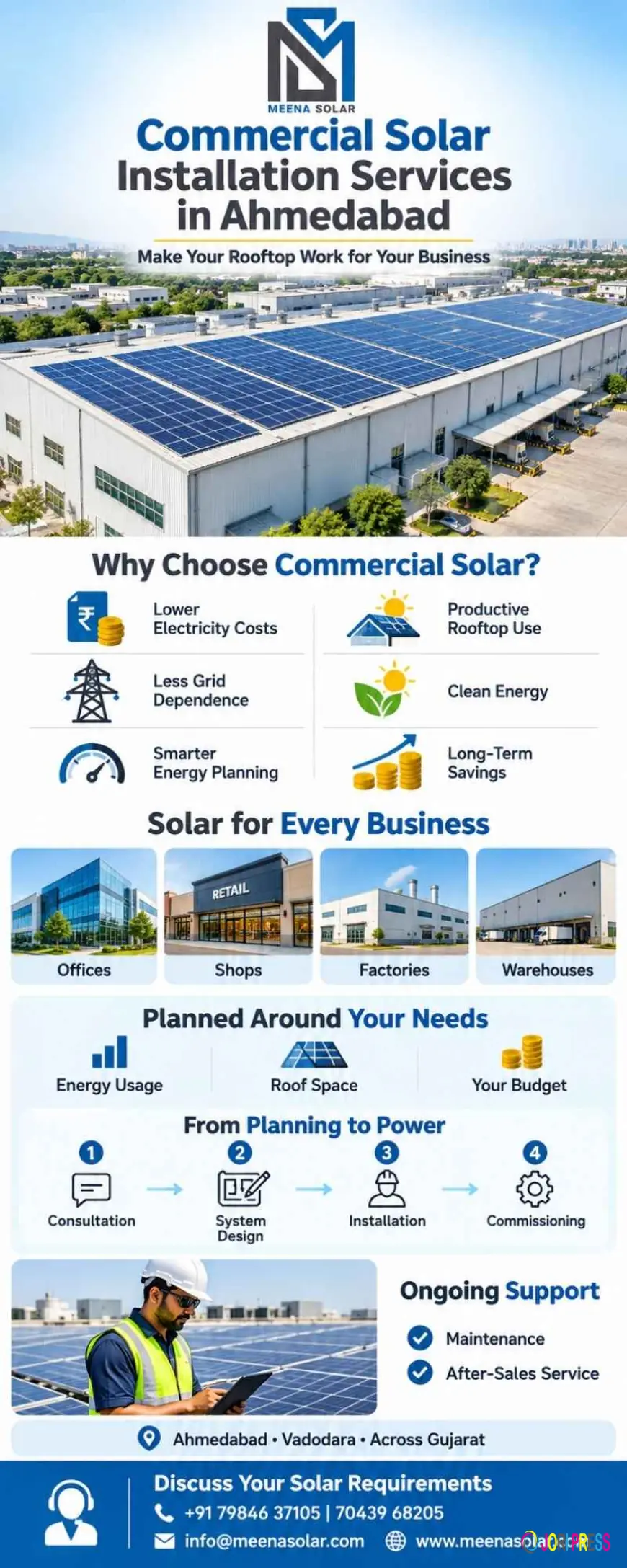
Commercial Solar Installation in Ahmedabad
Electricity expenses can affect a business's profitability, especially when offices, factories, warehouses, and retail stores consume power throughout the day. As operating costs continue to influence business decisions, many companies are exploring practical ways to manage their energy consumption. Commercial Solar Installation offers an opportunity to generate electricity from sunlight, reduce dependence on grid power, and make better use of available rooftop space.
However, choosing a solar system requires more than installing panels on a building. Businesses must consider electricity consumption, roof conditions, equipment quality, installation costs, and future energy requirements. With proper planning, rooftop solar can become a valuable part of a company's long-term energy strategy.
Whether you operate a small office, a retail outlet, or a large industrial facility, understanding your solar options can help you make a more informed investment.
Why Commercial Solar Installation Makes Sense for Modern Businesses
Businesses need reliable electricity to support daily operations. Lighting, air conditioning, computers, refrigeration, production machinery, and other equipment contribute to monthly electricity expenses. Therefore, finding ways to manage these costs can improve financial planning.
Commercial Solar Installation allows businesses to generate electricity on-site and use it to support their regular operations. Moreover, commercial buildings often have large rooftops that can accommodate solar panels without requiring additional land.
01. Reduce Electricity Expenses with Commercial Solar Installation
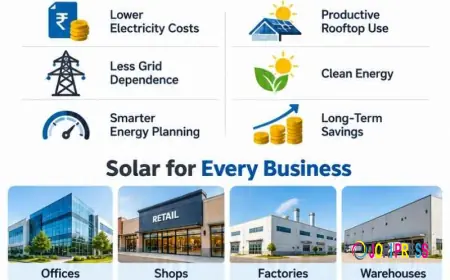
One of the main reasons businesses explore solar power is the potential to reduce electricity bills. A suitably designed solar system generates electricity during daylight hours, allowing businesses to use solar energy instead of purchasing the same amount of electricity from the grid.
For example, offices can use solar generation to support computers, lighting, air conditioning, and other essential equipment. Similarly, retail stores and warehouses can use solar electricity to operate lighting, cooling systems, and selected machinery during business hours.
The actual savings depend on system capacity, electricity tariffs, daytime consumption, weather conditions, and applicable billing arrangements. Consequently, reviewing recent electricity bills is an important first step before selecting a system.
02. Make Better Use of Available Rooftop Space
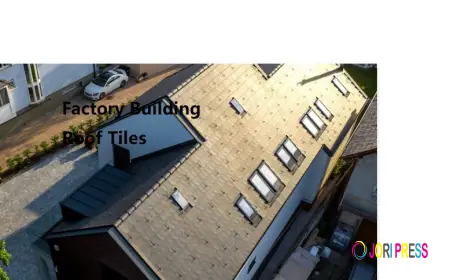
Commercial properties often have substantial rooftop areas that remain unused. Solar panels can turn suitable roof space into a productive source of renewable electricity.
However, the installation team should assess the roof's structural condition, available area, shading, orientation, waterproofing, and access requirements. These checks help determine the system capacity the property can reasonably support.
Additionally, a well-planned layout should allow safe access for maintenance and inspection. Businesses must also consider existing water tanks, ventilation systems, rooftop equipment, and future building modifications.
By evaluating these factors before installation, property owners can make better use of their rooftops while reducing the risk of avoidable project complications.
03. Improve Energy Independence for Your Business
Electricity supply plays an important role in maintaining business operations. Although most commercial properties continue to depend on the grid, on-site solar generation can reduce the amount of electricity they purchase during sunny hours.
This advantage can be particularly useful for businesses with high daytime consumption. Offices, retail outlets, workshops, and some manufacturing facilities may use a substantial portion of their solar generation directly.
Nevertheless, standard grid-connected solar systems generally shut down during a power outage for safety reasons. Businesses that require backup electricity should discuss suitable battery storage, hybrid inverters, and critical-load arrangements with their installation provider.
04. Support Sustainability Through Clean Energy
Solar energy provides electricity without direct fuel combustion during operation. As a result, using solar power can help businesses reduce emissions associated with the electricity they consume, depending on the energy sources replaced.
Furthermore, companies can incorporate renewable energy into their sustainability initiatives and long-term environmental planning. This approach may also strengthen their communication with customers, employees, suppliers, and business partners who value responsible energy practices.
Solar power therefore offers more than a potential financial advantage. It can also support a business's efforts to use resources more efficiently and adopt cleaner energy solutions.
05. Plan for Long-Term Business Energy Requirements
A suitable solar system should address current electricity consumption as well as future business plans. For instance, a company may expand its production capacity, add new machinery, increase office space, or introduce electric vehicle charging.
Considering these possibilities early helps businesses choose a system that aligns with their expected energy requirements. However, installing the largest possible system does not always deliver the best financial outcome.
Instead, businesses should assess their consumption patterns, available roof space, permitted installation capacity, and the value of electricity exported to the grid. This approach helps balance system cost with practical energy benefits.
How to Choose the Right Commercial Solar Installation Partner
Selecting the right installation partner is an important step towards a successful solar project. A professional provider should understand the property's energy requirements, recommend appropriate equipment, plan the installation carefully, and explain the support available after commissioning.
Before making a decision, businesses should compare technical proposals, installation quality, warranty terms, and overall project value.
01. Evaluate Your Business Electricity Consumption
Start by reviewing your recent electricity bills, preferably covering the previous twelve months. These records can reveal average consumption, seasonal changes, electricity charges, and periods of higher demand.
Next, identify when your business consumes the most electricity. A company that operates mainly during daylight hours may benefit from direct solar consumption. In contrast, a facility that uses most of its electricity at night may need a different energy strategy.
An experienced solar professional can use this information to estimate an appropriate system capacity. The assessment should also consider operating schedules, future expansion, and any backup power requirements.
02. Assess Your Roof Before Commercial Solar Installation
A rooftop assessment helps determine whether the property can accommodate a solar system safely and efficiently. The installation team should examine roof dimensions, structural strength, shading, orientation, drainage, and access routes.
They should also consider inverter placement, cable routing, earthing, electrical protection, and other relevant safety requirements. For older buildings, a structural assessment may be necessary before installation begins.
Moreover, identifying roof repairs or waterproofing concerns in advance can help prevent additional work after the panels are installed.
03. Check Available Space and Shading
Solar panels need suitable exposure to sunlight to generate electricity effectively. Nearby buildings, trees, rooftop structures, and equipment may cast shadows that reduce generation.
Therefore, the system designer should evaluate shading throughout the day and plan panel placement accordingly. The final layout should also maintain suitable spacing for maintenance and comply with applicable installation requirements.
04. Compare Solar Equipment and Technical Specifications
Solar panels, inverters, mounting structures, cables, and electrical protection devices all influence system performance and safety. Therefore, businesses should compare complete technical proposals rather than choosing a provider solely on the lowest price.
Before approving a quotation, review the following details:
-
- Solar panel manufacturer, model, rated capacity, and applicable warranty.
- Inverter specifications, efficiency, monitoring features, and warranty coverage.
- Mounting structure materials, corrosion protection, and roof compatibility.
- Cable specifications, earthing, and electrical safety provisions.
- Estimated electricity generation and the assumptions behind the calculation.
- Installation scope, commissioning, maintenance, and after-sales support.
Additionally, ask for written information about exclusions, payment milestones, warranty claims, and maintenance responsibilities. Clear documentation helps avoid misunderstandings and allows a fair comparison between different proposals.
Understand the Commercial Solar Installation Process
A well-organised project generally progresses through consultation, site assessment, system design, equipment selection, installation, testing, and commissioning. Each stage helps ensure that the final system meets the property's practical requirements.
01. System Design and Equipment Selection
The design stage translates the business's electricity requirements and roof conditions into a suitable solar configuration. The designer considers panel placement, inverter capacity, mounting arrangements, electrical connections, and estimated generation.
Equipment selection should reflect technical compatibility, expected operating conditions, warranty terms, and the property's energy requirements. Furthermore, the proposal should explain the expected system output without promising unrealistic savings.
A clear design also helps businesses understand the installation scope, project timeline, and responsibilities before work begins.
02. Installation, Testing and Commissioning
During installation, the team fits the mounting structures, secures the panels, connects the electrical components, and completes the required safety checks. Qualified professionals should follow applicable electrical standards and relevant local requirements.
After installation, the team should test the system, confirm its operation, and provide appropriate documentation. Depending on the project and local regulations, utility coordination, approvals, and metering arrangements may also apply.
Businesses should request operating instructions, warranty documents, and access to monitoring facilities where available. These resources make it easier to understand system performance after commissioning.
Commercial Solar Installation Services in Ahmedabad and Gujarat
Businesses searching for Commercial Solar Installation in Ahmedabad should look for providers that understand commercial rooftops, business electricity requirements, installation planning, and local project conditions.
Meena Solar provides commercial rooftop solar solutions for businesses seeking to manage electricity expenses and use their available roof space productively. Its project support includes consultation, system planning, installation, and ongoing assistance according to individual project requirements.
Whether a business operates an office, retail outlet, factory, or warehouse, the initial assessment should consider electricity consumption, roof suitability, budget, and operational needs. These details help establish a practical basis for selecting system capacity and equipment.
Businesses in Vadodara and across Gujarat can also compare proposals based on technical specifications, expected generation, installation quality, warranty coverage, and after-sales support. By reviewing these factors together, decision-makers can assess the overall value of a project rather than focusing only on its initial cost.
Before proceeding, businesses should confirm applicable approvals, metering requirements, and any incentives with the relevant authorities or electricity distribution company.
Final Thoughts on Commercial Solar Installation
Commercial Solar Installation offers businesses an opportunity to manage electricity consumption, use rooftop space effectively, and support their sustainability objectives. With a suitable system, companies may reduce their reliance on grid electricity during daylight hours and improve their long-term energy planning.
However, successful results depend on careful preparation. Businesses should review electricity bills, assess roof conditions, compare equipment specifications, and understand installation and maintenance requirements before committing to a project.
A transparent quotation and realistic financial assessment can also help decision-makers understand the potential benefits and limitations of rooftop solar.
For businesses exploring solar solutions in Ahmedabad, Vadodara, and across Gujarat, the next step is to arrange a professional site assessment and compare suitable proposals. By choosing a system that matches actual energy needs, businesses can make a more informed investment in renewable electricity and long-term operational efficiency.
What's Your Reaction?
 Like
0
 Dislike
0
 Love
0
 Funny
0
 Angry
0
 Sad
0
 Wow
0