






























Can Solar Run AC All Day? Myth vs Reality
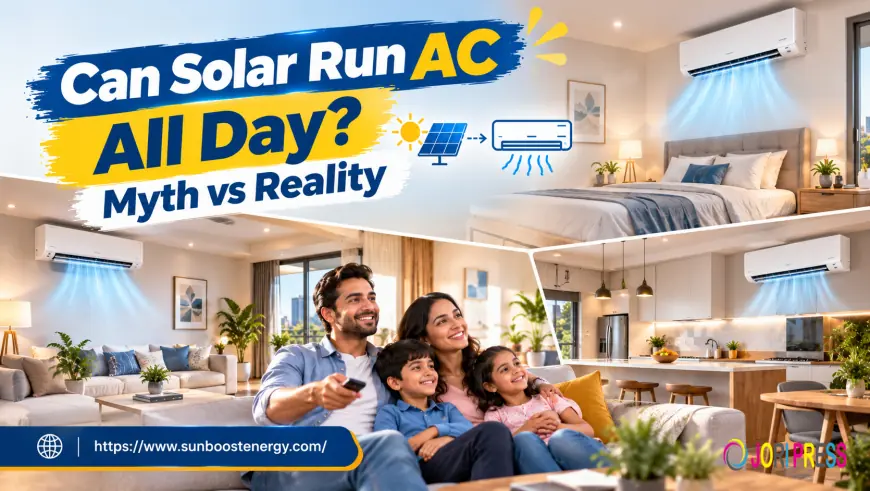
Running an air conditioner for long hours can make summer electricity bills uncomfortable, especially in hotter parts of India. This leads many homeowners to ask whether rooftop solar can run an AC throughout the day.
The short answer is yes; a properly sized solar system can support an AC during daylight hours. However, the result depends on the AC’s power consumption, solar capacity, available sunlight and other appliances operating at the same time.
Solar does not give every home unlimited AC use. The system must be designed around the household’s actual electricity requirements.
Myth: Any Solar System Can Run an AC All Day
A small solar system may generate enough electricity for lights, fans and a refrigerator, but it may not comfortably support an AC alongside other household appliances.
The solar capacity required depends on:
- AC tonnage and power rating
- Inverter or fixed-speed AC technology
- Star rating and energy efficiency
- Daily operating hours
- Room size and insulation
- Temperature setting
- Other appliances running simultaneously
- Local sunlight and roof conditions
A 1-ton energy-efficient inverter AC will normally use less electricity than an older 2-ton fixed-speed unit. That is why AC tonnage alone is not enough to select a solar system.
Reality: Solar Can Support an AC During Daylight Hours
Solar panels produce electricity when sunlight reaches them. Generation usually rises during the morning, reaches its strongest level around the middle of the day and then reduces towards evening.
When an AC operates during these hours, solar electricity can cover some or all of its demand. If the AC and other appliances consume more power than the panels are producing, the grid supplies the balance in a grid-connected system.
For example, your solar system may be generating 3kW while your AC, refrigerator, fans and other appliances are using 3.5kW. Solar will supply the available 3kW, while the remaining 0.5kW will come from the grid.
A properly designed Rooftop Solar System should account for total household demand, not just the air conditioner.
How Much Power Does an AC Consume?
AC consumption varies by model and operating conditions. As a broad reference, an efficient 1.5-ton inverter AC may draw approximately 1kW to 1.8kW while running. Actual consumption may move above or below this range.
Inverter ACs adjust compressor speed once the room reaches the selected temperature. Their electricity use is therefore not constant throughout the day.
Consumption can increase when:
- The outdoor temperature is extremely high
- The room has poor insulation
- Doors or windows remain open
- AC filters are dirty
- The temperature is set very low
- The unit is too small for the room
- The AC requires maintenance
Check out the appliance label or product documentation for its rated input power before calculating solar capacity.
Can a 3kW Solar System Run an AC?
A 3kW solar system may support one efficient AC during good sunlight, particularly when other heavy appliances are not being used simultaneously.
However, the system will not produce its full rated capacity every minute. Clouds, panel temperature, shade, orientation and normal system losses affect real-time output.
If the AC is running alongside an electric geyser, water pump, induction cooktop or another AC, the household may still draw electricity from the grid. A 3kW system can reduce AC-related grid consumption, but it should not automatically be treated as an unlimited cooling solution.
Is a Larger Solar System Better for AC Usage?
A larger solar system offers more capacity for an AC and other household loads, but bigger is not always better.
The correct size should be based on electricity bills, daytime consumption, usable roof space and future needs. Installing excessive capacity without considering consumption and applicable grid rules may increase the initial cost without delivering equal value.
A home using multiple ACs for long daytime hours will generally need more solar capacity than a household operating one efficient AC for a few hours.
Myth: Solar Can Run an AC at Night Without a Battery
Solar panels do not generate electricity after sunset. A grid-connected home will use grid electricity to operate the AC at night.
To run an AC using stored solar energy, the home needs a compatible battery, inverter and backup configuration. The battery must also have enough usable capacity and power output to support the AC.
ACs consume considerable energy, so a small battery may run out quickly. Battery sizing should consider:
- AC running power
- Required backup duration
- Other essential appliances
- Usable battery capacity
- Inverter output rating
- Battery reserve settings
- Charging conditions
Adding a battery does not automatically mean the AC can run throughout the night. The complete setup must be calculated correctly.
Myth: Solar Will Run the AC During Every Power Cut
A standard grid-connected solar system generally switches off during a power outage for safety. This prevents electricity from being sent into grid lines while repair work may be underway.
If blackout operation is important, the system must be designed with compatible backup equipment and selected backup circuits. Homeowners should discuss this requirement before installation because it affects the inverter, battery and electrical design.
How to Use AC More Efficiently with Solar?
The way you use your AC can improve the value received from solar.
Try these practical steps:
- Run the AC during stronger solar-generation hours
- Set a reasonable room temperature
- Keep doors and windows closed
- Clean filters regularly
- Use curtains to reduce indoor heat
- Avoid operating several heavy appliances together
- Monitor solar generation and household consumption
- Choose an energy-efficient AC suited to the room
For office-goers, scheduling the AC before leaving for work may not provide much value. Families working from home can often use more solar electricity directly during the day.
Can Solar Run Your AC All Day?
Solar can support daytime AC use when the system is correctly sized and sunlight conditions are suitable. Grid electricity may still be required during cloudy periods, early mornings, evenings or whenever household demand exceeds solar production.
Running an AC after sunset requires grid power or a properly sized battery system. The best approach is to review your electricity bills, AC usage, roof space and daily consumption before choosing solar capacity.
Sunboost Energy can assess your AC load, household electricity use and rooftop conditions before recommending a suitable residential solar solution.
What's Your Reaction?
 Like
0
Like
0
 Dislike
0
Dislike
0
 Love
0
Love
0
 Funny
0
Funny
0
 Angry
0
Angry
0
 Sad
0
Sad
0
 Wow
0
Wow
0