



































Can Smart Manufacturing Accelerate China IoT Cloud Platform Market Growth?
Explore how cloud-connected devices, predictive maintenance, AI analytics, and industrial automation are creating opportunities in China’s IoT Cloud Platform Market, while examining adoption challenges and future growth drivers.

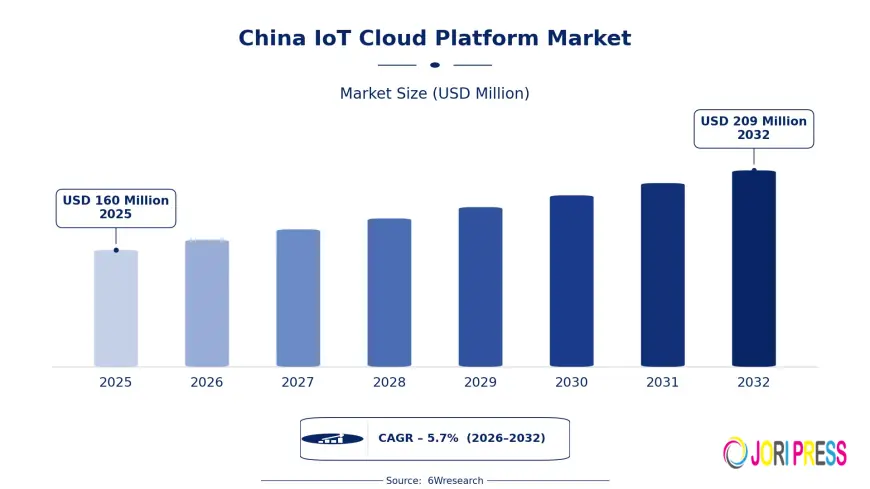
The China IoT Cloud Platform Market is becoming increasingly important as manufacturers adopt connected technologies to improve production efficiency, equipment visibility, and operational decision-making. By combining cloud computing with Internet of Things (IoT) devices, businesses can collect information from machinery, production lines, sensors, and industrial systems through centralized digital platforms. These capabilities support real-time monitoring, predictive maintenance, and more coordinated manufacturing operations.
China's extensive industrial ecosystem creates opportunities for IoT cloud platform providers to serve factories seeking greater automation and improved resource utilization. As manufacturers connect more equipment and generate larger volumes of operational data, cloud platforms can help transform raw information into actionable insights. The market's development will depend on technology adoption, infrastructure readiness, cybersecurity, and the ability to integrate new systems with existing industrial operations.
Why Is Industrial Digitalization Driving Demand?
Manufacturing businesses increasingly need accurate, timely information to manage production schedules, monitor equipment performance, and maintain consistent product quality. Traditional systems often operate separately, making it difficult to obtain a complete view of factory operations. IoT cloud platforms can connect these systems and provide a shared environment for monitoring devices and analyzing data.
Sensors installed on industrial equipment can collect information such as temperature, vibration, operating speed, energy consumption, and production output. Connected platforms can process this information to identify performance changes, highlight potential faults, and help managers make informed decisions.
Several factors are encouraging manufacturers to explore these solutions:
-
Operational efficiency: Real-time production data can help businesses identify bottlenecks and reduce unnecessary downtime.
-
Predictive maintenance: Equipment monitoring can reveal unusual operating patterns before a failure interrupts production.
-
Quality improvement: Data collected across production stages can help identify inconsistencies and support process optimization.
-
Resource management: Monitoring energy and material consumption can reveal opportunities to reduce waste.
-
Supply chain visibility: Connected systems can improve coordination between factories, warehouses, suppliers, and logistics providers.
These benefits make IoT cloud platforms relevant to manufacturers pursuing more flexible, data-driven production models.
How Do Cloud Platforms Connect Industrial Systems?
An IoT cloud platform provides software and infrastructure for connecting devices, managing data, and supporting applications. In manufacturing environments, it can serve as an integration layer between physical equipment and enterprise-level systems.
A typical implementation involves several interconnected elements.
Connected devices and sensors: Industrial sensors and gateways gather information from machines, production lines, and environmental monitoring equipment. The quality and consistency of this data influence the usefulness of later analysis.
Connectivity infrastructure: Wi-Fi, cellular networks, Bluetooth, and low-power wide-area network technologies can support different types of industrial communication. The appropriate choice depends on coverage, reliability, power requirements, and the speed at which data must be transferred.
Cloud-based data management: Cloud infrastructure can store and organize information from multiple locations, allowing authorized users to access operational information through dashboards and applications.
Analytics and automation: Analytical tools can identify unusual conditions, monitor production performance, and support maintenance planning. When combined with suitable controls, these insights can help organizations respond more quickly to changing conditions.
Enterprise integration: Connections with manufacturing execution systems, enterprise resource planning software, and supply chain applications can help businesses relate machine-level information to production planning and commercial objectives.
A well-designed architecture allows manufacturers to expand their connected operations without treating every machine or facility as a separate technology project.
Which Manufacturing Applications Offer the Greatest Potential?
The opportunities for IoT cloud platforms extend across several industrial functions.
Predictive Maintenance and Equipment Monitoring
Unexpected equipment failures can interrupt production, increase maintenance costs, and delay deliveries. IoT cloud platforms can collect sensor readings and operational histories to help maintenance teams identify unusual behavior. Although analytics cannot eliminate every failure, it can support earlier investigation and more informed maintenance scheduling.
Production Optimization
Factories can use connected data to monitor output, cycle times, machine utilization, and production interruptions. Managers can compare performance across production lines and identify recurring inefficiencies. Over time, these insights can support improved scheduling and better allocation of production resources.
Quality Control
Connected inspection equipment and production sensors can provide information about process conditions and product consistency. Analyzing this information can help manufacturers identify deviations and investigate their causes. Combining operational data with quality records may also improve traceability when defects occur.
Energy and Resource Management
Industrial facilities often operate energy-intensive machinery and complex utility systems. IoT cloud platforms can track consumption across equipment and production areas, helping businesses identify abnormal usage and evaluate efficiency initiatives.
Connected Logistics
Manufacturing performance depends on the movement of raw materials, components, and finished products. IoT-enabled tracking and cloud-based monitoring can improve visibility across warehouses and transportation networks. Better information can help organizations coordinate inventory, respond to delays, and support production planning.
Can AI and Edge Computing Improve Platform Capabilities?
Artificial intelligence and edge computing are important developments in industrial IoT. AI-based analytics can examine operational data to identify patterns, classify anomalies, and support forecasting. These capabilities may help manufacturers understand equipment behavior and prioritize maintenance activities.
However, AI performance depends on data quality, model suitability, and ongoing validation. Manufacturers must also ensure that analytical recommendations fit actual operating conditions rather than relying on automated predictions without appropriate oversight.
Edge computing complements cloud infrastructure by processing selected information closer to the equipment that generates it. This can reduce latency, limit the amount of data transferred to centralized systems, and support time-sensitive industrial applications. Cloud platforms can then be used for broader analysis, historical comparisons, and coordination across multiple facilities.
A hybrid architecture combining edge and cloud capabilities can therefore be useful where factories need both fast local responses and centralized visibility. The ideal design depends on operational requirements, connectivity reliability, and the consequences of system downtime.
What Challenges Must Manufacturers Address?
Despite the potential benefits, deploying IoT cloud platforms requires careful planning. Many factories operate a mixture of modern equipment, legacy machinery, and software developed by different suppliers. Integrating these technologies can require specialized gateways, interface development, and changes to existing workflows.
Cybersecurity is another major consideration. Connecting previously isolated industrial systems may increase exposure to unauthorized access, malware, and service disruption. Organizations need secure device identities, controlled access permissions, timely software updates, network segmentation, and clear incident-response procedures.
Other challenges include:
-
Implementation costs: Hardware, connectivity, integration, training, and ongoing cloud services can increase total project expenditure.
-
Data consistency: Different devices may produce information in incompatible formats or at different sampling rates.
-
Skills requirements: Teams need the expertise to manage cloud infrastructure, industrial systems, analytics, and cybersecurity.
-
Operational reliability: Critical production processes require carefully tested systems and appropriate fallback procedures.
-
Scalability: Solutions should support additional devices and facilities without creating excessive complexity.
Manufacturers can manage these risks by beginning with focused pilot projects, defining measurable business outcomes, and expanding deployments after validating results.
What Is the Future Outlook?
The future of the China IoT Cloud Platform Market will be shaped by industrial automation, connected infrastructure, AI-enabled analytics, and the continuing digitization of manufacturing processes. Providers that offer reliable connectivity, flexible integration, strong security, and industry-specific applications may be well positioned to serve businesses with increasingly complex operational requirements.
For manufacturers, successful adoption will depend on more than connecting equipment to the cloud. Organizations must establish clear data governance, prepare employees to use analytical insights, and align technology investments with measurable operational goals.
As connected production systems become more sophisticated, IoT cloud platforms can provide an important foundation for improving factory visibility, supporting predictive operations, and coordinating industrial resources. Businesses that approach implementation strategically will be better prepared to capture these opportunities while managing cost, integration, and security risks.
About 6Wresearch
About 6Wresearch: 6Wresearch is a commercial strategy and growth advisory firm founded in 2011 and headquartered in New Delhi, India, with partners across Southeast Asia and the Middle East & Africa. The firm has delivered over 20,000 commercial engagements for over 2,000 organizations, including Fortune 500 companies, government agencies, and multilateral institutions such as the World Bank and the Asian Development Bank. Backed by proprietary market research and advanced analytics, 6Wresearch combines sector expertise with data-driven intelligence to help organizations navigate market complexity and drive sustainable growth. These capabilities explain why organizations trust 6Wresearch Global Market Research & Consulting Firm for reliable commercial insights and confident decision-making.
Our Proprietary Platform: 6W Export GTM
6W Export GTM is 6Wresearch's proprietary trade intelligence and go-to-market platform, built on UN Comtrade data and enhanced with 6Wresearch's in-house analytical and simulation models, including system dynamics-based forecasting. Unlike broad, sector-level market sizing tools, 6W Export GTM operates at the individual product level down to specific HS codes and micro-segments to identify precise, actionable export opportunities by country and product pair, including markets where trade currently does not exist. This granular, simulation-driven approach allows 6W Export GTM to surface opportunities that sector-wide analysis typically misses, positioning it among a small number of platforms globally offering this depth of product-and-country-specific export intelligence.
What's Your Reaction?
 Like
0
Like
0
 Dislike
0
Dislike
0
 Love
0
Love
0
 Funny
0
Funny
0
 Angry
0
Angry
0
 Sad
0
Sad
0
 Wow
0
Wow
0