


































BIS CRS Registration in India – Process, Cost and Documents
Learn about BIS CRS Registration in India, including the process, documents, cost, testing requirements, and how a BIS CRS Consultant can help.
If you manufacture, import, or sell electronic and IT products in India, obtaining BIS CRS Registration may be an essential regulatory requirement for products covered under the Compulsory Registration Scheme (CRS). The scheme is administered by the Bureau of Indian Standards (BIS) and applies to notified products that must comply with the applicable Indian Standard.
The BIS CRS Registration process involves product testing, preparation of technical documents, online application, and review by BIS. For manufacturers and importers unfamiliar with the process, working with an experienced BIS CRS Consultant can make the registration process more structured and manageable.
In this guide, we explain the BIS CRS registration process, documents, costs, testing requirements, and the role of a consultant.
What is BIS CRS Registration?
BIS CRS Registration refers to registration under the Compulsory Registration Scheme (CRS) operated by BIS for specified electronics and IT products.
Under the CRS framework, notified products are required to conform to the applicable Indian Standard and meet the requirements prescribed under the relevant government notification. BIS maintains a list of products covered under Scheme II (Registration Scheme), which includes various electronics and IT products.
The CRS framework primarily addresses product safety and conformity requirements. BIS explains that products covered under CRS cannot be manufactured, imported, sold, or distributed without complying with the applicable requirements and bearing the required BIS Standard Mark and registration number.
Which Products Require BIS CRS Registration?
BIS CRS applies to products specifically notified under the applicable government orders.
Examples of products covered by the scheme include certain:
-
Laptops, notebooks and tablets
-
Electronic games
-
Televisions and display products
-
Set-top boxes
-
Automatic data processing machines
-
Power adaptors
-
Electronic and IT equipment
-
Audio/video equipment
-
Other notified electronic products
The applicable product list and standards can change through amendments and notifications. For example, BIS's current Scheme II information includes products assessed against IS/IEC 62368 Part 1:2023 as well as other applicable Indian Standards.
Therefore, businesses should verify the applicable standard and notification for their specific product before beginning the application.
Why is BIS CRS Registration Important?
BIS CRS registration helps demonstrate that a covered product complies with the applicable Indian Standard and regulatory requirements.
For manufacturers and importers, registration can be important for:
-
Legal market entry of notified products
-
Demonstrating product conformity
-
Meeting applicable government requirements
-
Supporting import and sales activities
-
Building customer confidence
-
Maintaining regulatory compliance
If a product falls under the compulsory registration framework, businesses should complete the applicable BIS requirements before commercializing the product in India.
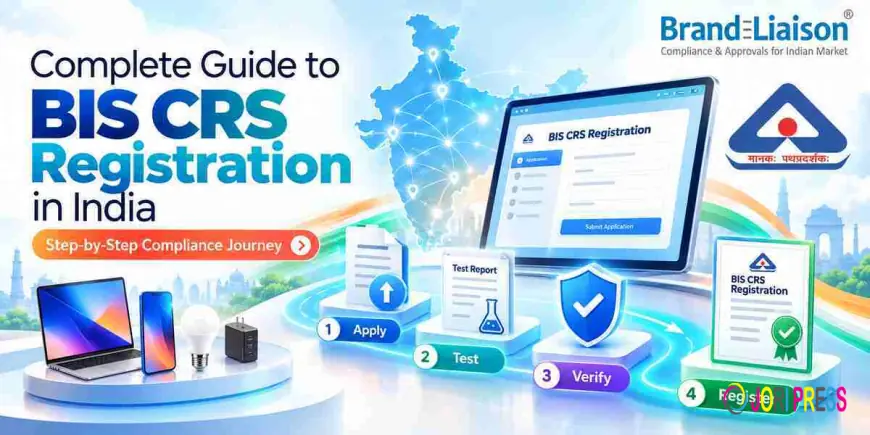
BIS CRS Registration Process in India
The general BIS CRS Registration process can be explained through the following stages.
Step 1: Identify the Applicable Indian Standard
The first step is determining whether the product is covered under CRS and identifying the applicable Indian Standard.
Product specifications, technology, functionality, category, and applicable government notifications should be reviewed carefully.
Choosing the correct standard is important because the product will need to be tested against the applicable requirements.
Step 2: Select a BIS-Recognized Laboratory
CRS products need to undergo testing through an applicable BIS-recognized laboratory.
BIS states that for CRS registration, applicants create the test request through the CRS portal. After selecting the laboratory, the test request is transferred to the LIMS portal. Laboratory details and applicable testing charges are available through the LIMS system.
Step 3: Product Testing
The product sample is submitted to the selected laboratory for testing according to the applicable Indian Standard.
The laboratory evaluates the product against the relevant technical and safety requirements.
A successful test report is an important part of the CRS registration application.
Step 4: Prepare Required Documents
After obtaining the applicable test report, the applicant needs to prepare the required documentation.
Documents may include:
-
Test report
-
Product specifications
-
Product photographs
-
Technical literature
-
Manufacturer information
-
Trademark information
-
Factory details
-
Authorized signatory information
-
Product details and model numbers
-
Undertakings and declarations, where applicable
-
Other documents prescribed by BIS
The exact document requirements may vary depending on the product and application.
Step 5: Online CRS Application
The application is submitted through the applicable BIS CRS online system along with the required information, documents, test report, and applicable fees.
The applicant needs to ensure that the details in the application are consistent with the test report and product documentation.
Step 6: BIS Review
BIS reviews the application and supporting documents.
If BIS identifies any deficiency or requires clarification, the applicant may need to provide additional information or corrections.
A BIS CRS Consultant can assist the applicant in preparing responses to such queries and coordinating the application process.
Step 7: Grant of BIS CRS Registration
Once the application successfully meets the applicable requirements, BIS grants the registration.
The registered product can then be marketed in India in accordance with the applicable CRS requirements, including the prescribed BIS Standard Mark and registration details.
Documents Required for BIS CRS Registration
The exact documentation depends on the product and application. Common documents may include:
Product Test Report
A valid test report from the applicable BIS-recognized laboratory is one of the key documents for CRS registration.
Manufacturer Details
Details of the manufacturing unit and manufacturer are required for the application.
Product Information
Applicants may need to provide:
-
Product name
-
Model number
-
Product description
-
Technical specifications
-
Ratings
-
Product photographs
-
Brand/trademark details
Technical Documents
Depending on the product, relevant technical documents may include:
-
Datasheets
-
User manuals
-
Circuit diagrams
-
Product specifications
-
Component details
-
Technical literature
Authorization Documents
Where applicable, authorization or representative-related documents may be required, particularly where the applicant and manufacturer are different entities.
Undertakings and Declarations
Certain declarations, undertakings, or other prescribed documents may also be required as part of the application.
A BIS Consultant in India can help prepare and review the documentation before submission to minimize avoidable deficiencies.
BIS CRS Registration Cost in India
The total BIS CRS Certification Cost is not the same for every product.
The overall cost can depend on factors such as:
-
BIS application fees
-
BIS processing fees
-
Laboratory testing charges
-
Number of models or variants
-
Number of test reports
-
Additional testing requirements
-
Inclusion of additional models
-
Consultant/service charges, if applicable
BIS's published CRS fee document specifies application and processing fees and also provides separate charges for additional test reports and other activities.
For example, the cited BIS fee document lists an application fee of ₹1,000 and a processing fee of ₹10,000 including one test report, with additional processing charges for additional test reports. However, applicants should verify the current applicable BIS fee structure before making payment because fee schedules and regulatory requirements can be amended.
Laboratory testing charges are separate and depend on the product and testing requirements. BIS states that CRS laboratory testing charges are available through the LIMS portal.
Therefore, instead of relying on a fixed “BIS CRS registration cost,” manufacturers and importers should obtain a product-specific cost assessment.
How Long Does BIS CRS Registration Take?
The time required for BIS CRS registration can vary depending on:
-
Product category
-
Testing requirements
-
Laboratory testing time
-
Completeness of documents
-
Number of models
-
BIS application review
-
Queries or deficiencies
-
Applicant's response time
A complete application with a suitable test report and properly prepared documents can generally move more efficiently than an application requiring repeated corrections.
Businesses should therefore begin testing and documentation preparation well before their planned product launch.
Role of a BIS CRS Consultant
A professional BIS CRS Consultant can support manufacturers and importers through different stages of the registration process.
Consultancy support may include:
Product Compliance Assessment
Reviewing the product and determining the applicable CRS requirement and Indian Standard.
Testing Guidance
Helping identify the applicable testing requirements and coordinating with the relevant laboratory.
Documentation Support
Reviewing technical documents, manufacturer information, product details, test reports, and application documents.
Application Assistance
Supporting the preparation and submission of the online CRS application.
Query and Deficiency Support
Assisting with responses when BIS raises questions or identifies deficiencies in an application.
Registration Follow-Up
Coordinating the application process and keeping track of pending requirements until registration is granted.
BIS CRS Registration for Foreign Manufacturers
Foreign manufacturers supplying electronic and IT products to India should evaluate BIS CRS requirements before exporting products to the Indian market.
A foreign manufacturer may need to coordinate product testing, technical documentation, Indian representative-related requirements, and application formalities.
An experienced BIS CRS Consultant can help international manufacturers understand the Indian compliance process and coordinate the documentation and testing requirements.
Common Mistakes to Avoid During BIS CRS Registration
1. Selecting the Wrong Standard
The product must be evaluated against the applicable Indian Standard. Incorrect standard selection can result in unnecessary testing and delays.
2. Testing the Wrong Product Configuration
The sample submitted for testing should properly represent the model or family covered by the application.
3. Mismatch in Product Details
The model number, brand, manufacturer name, specifications, and other information should remain consistent across the test report, application, and supporting documents.
4. Incomplete Documentation
Missing documents can result in deficiencies and additional processing time.
5. Ignoring Product Variants
Manufacturers should understand the applicable grouping and model/family requirements before testing multiple variants.
6. Using Outdated Regulatory Information
BIS standards, product lists, notifications, and requirements can change. Applicants should verify the current requirements before applying.
Why Choose Brand Liaison for BIS CRS Registration?
Brand Liaison supports manufacturers, importers, and brands with product compliance requirements for the Indian market.
As an experienced BIS CRS Consultant in Delhi, India, Brand Liaison can assist with:
-
Product requirement assessment
-
Applicable standard identification
-
Testing coordination
-
Documentation support
-
BIS CRS application assistance
-
Query and deficiency support
-
Registration follow-up
Brand Liaison works with businesses seeking BIS CRS Certification for electronic products and helps streamline the compliance process from requirement assessment through registration.
Frequently Asked Questions About BIS CRS Registration
What is BIS CRS Registration?
BIS CRS Registration is the registration process under BIS's Compulsory Registration Scheme for notified electronic and IT products that are required to comply with applicable Indian Standards.
Is BIS CRS Certification mandatory?
For products specifically covered under the compulsory registration requirements, compliance is mandatory. BIS maintains the applicable list of products under Scheme II and related government notifications.
What documents are required for BIS CRS Registration?
Common documents include product test reports, manufacturer details, product specifications, photographs, technical literature, model information, and applicable declarations or authorization documents. Exact requirements depend on the product.
How much does BIS CRS Registration cost?
There is no single fixed total cost for every product. The overall expense can include BIS fees, laboratory testing charges, additional test reports, and professional consultancy charges. Current BIS fees and laboratory charges should be verified for the specific product.
Do I need a BIS CRS Consultant?
A consultant is not a substitute for the applicant's regulatory responsibilities, but professional consultancy can help manufacturers and importers understand the applicable requirements, coordinate testing, prepare documents, submit applications, and address deficiencies.
Can foreign manufacturers obtain BIS CRS Registration?
Yes, foreign manufacturers supplying products covered by CRS to India need to assess and meet the applicable BIS requirements. The application and representative requirements should be evaluated based on the specific product and applicant structure.
Conclusion
BIS CRS Registration is an important compliance requirement for electronic and IT products covered under India's Compulsory Registration Scheme. From identifying the applicable Indian Standard and completing laboratory testing to preparing documents and submitting the online application, each stage needs careful attention.
The cost of BIS CRS Certification depends on the product, testing requirements, number of models, applicable BIS fees, and other factors. Similarly, the documentation requirements can vary according to the product category.
For manufacturers, importers, and international brands, working with an experienced BIS CRS Consultant in India can make the compliance process more organized and help reduce avoidable documentation and application issues.
Brand Liaison provides BIS CRS consultancy support for businesses seeking to bring compliant electronic and IT products to the Indian market.
What's Your Reaction?
 Like
0
 Dislike
0
 Love
0
 Funny
0
 Angry
0
 Sad
0
 Wow
0