










































Badminton Grip Size Guide: Find the Best Fit for Your Hand
Choosing the correct badminton grip size can improve racket comfort and handling. Learn how to recognise grips that are too small or large and adjust them properly.
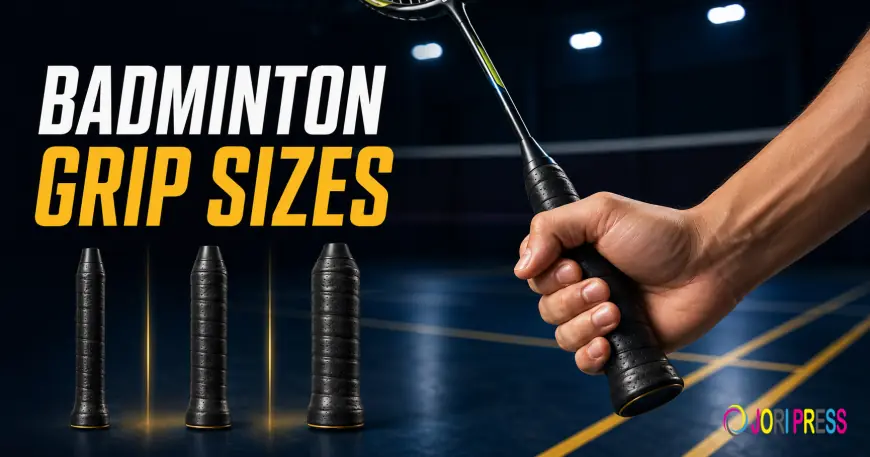
Learn how the thickness of your racket handle affects comfort, movement and control on the badminton court
A badminton racket may have the right weight, balance and string tension, but it can still feel uncomfortable when the grip does not fit your hand. Grip size affects how securely you hold the racket and how freely you can use your fingers and wrist.
Choosing the right grip is not about following what professional players use. It is about finding a handle thickness that feels comfortable in your own hand.
What Does Badminton Grip Size Mean?
Badminton grip size refers to the thickness of the racket handle. Racket manufacturers often mark grip sizes using codes such as G1, G2, G3, G4 and G5.
In many common sizing systems, a higher number represents a thinner grip. However, exact measurements can vary between brands. A G4 grip from one manufacturer may not feel identical to a G4 grip from another.
Players should check the manufacturer’s size information and hold the racket whenever possible before making a final decision.
Why Is the Right Grip Size Important?
The grip connects your hand to the racket. If the handle feels comfortable, you can move the racket more naturally and adjust your grip quickly during rallies.
Choosing a suitable grip may help you:
-
Hold the racket without excessive pressure
-
Move between forehand and backhand positions
-
Use your fingers during quick exchanges
-
Generate natural wrist movement
-
Control serves and net shots
-
Play comfortably during longer sessions
An uncomfortable grip can make you squeeze the handle too tightly, which may limit natural movement.
How to Test a Badminton Racket Grip
Hold the racket using a relaxed forehand grip. Allow your fingers to wrap around the handle naturally.
The racket should feel secure, but your hand should not feel cramped. You should also be able to rotate the handle smoothly when changing between forehand and backhand grips.
Try a few gentle racket movements. If the handle shifts easily or feels difficult to control, its thickness may need to be adjusted.
How to Know If the Grip Is Too Thin
Some players prefer a thin grip because it allows quick finger movements. However, a handle that is too thin may become difficult to control.
Common signs include:
-
Fingers pressing into the palm
-
Racket twisting during powerful strokes
-
Need to squeeze the handle firmly
-
Handle feeling loose or unstable
-
Hand becoming tired while playing
A thin handle is generally easy to customise because an overgrip can be added to increase its thickness.
How to Know If the Grip Is Too Thick
A thick grip can provide extra cushioning, but an oversized handle may limit wrist and finger movement.
Signs of an excessively thick grip include:
-
Difficulty wrapping your fingers around the handle
-
Slow forehand-to-backhand grip changes
-
Restricted wrist movement
-
Handle feeling bulky in your hand
-
Reduced control during delicate shots
Reducing a thick grip can be difficult. Therefore, choosing a slightly thinner handle and adjusting it later is often more practical.
What Is the Difference Between a Base Grip and an Overgrip?
The base or replacement grip is wrapped directly around the racket’s wooden handle. It is thicker and usually provides the main layer of cushioning.
An overgrip is a thinner layer applied over the base grip. It can improve surface feel, absorb moisture and increase the handle’s thickness.
Players can add an overgrip when the original handle feels slightly thin. However, adding too many layers may hide the bevelled shape of the handle and make grip changes less precise.
Should Beginners Use a Thin or Thick Grip?
Beginners should choose a grip that feels comfortable and allows them to learn the correct holding technique. The racket should remain secure without requiring a tight grip.
A slightly thinner handle can be a practical starting point because its thickness can be increased gradually with an overgrip. Players should test each adjustment instead of adding multiple layers immediately.
Comfort should be the priority, regardless of the grip number or another player’s preference.
Tips for Selecting the Correct Grip
Use these simple tips when testing a badminton racket:
-
Hold the racket before purchasing it when possible.
-
Test both forehand and backhand grip positions.
-
Check whether your fingers wrap around the handle naturally.
-
Avoid a grip that already feels too large.
-
Use an overgrip to customise a thinner handle.
-
Replace worn or slippery grips regularly.
-
Select the size that feels comfortable for your own hand.
Final Words
Badminton grip size may appear to be a minor racket specification, but it can make an important difference to comfort and handling. The correct grip should feel secure while allowing your fingers and wrist to move naturally.
Since racket manufacturers may use slightly different sizing systems, do not depend only on the printed grip number. Test the racket and adjust the thickness carefully until it feels right.
What's Your Reaction?
 Like
0
Like
0
 Dislike
0
Dislike
0
 Love
0
Love
0
 Funny
0
Funny
0
 Angry
0
Angry
0
 Sad
0
Sad
0
 Wow
0
Wow
0