

































Precision and Honor: The Ultimate Guide to World War 1 German Uniforms
Explore the historical evolution of World War 1 German uniforms from the M1910 Feldgrau to the M1916 Bluse. Learn how ReplicaMilitary manufactures museum-grade WW1 German uniform reproduction garments with absolute archival accuracy for living historians, film productions, and collectors globally.
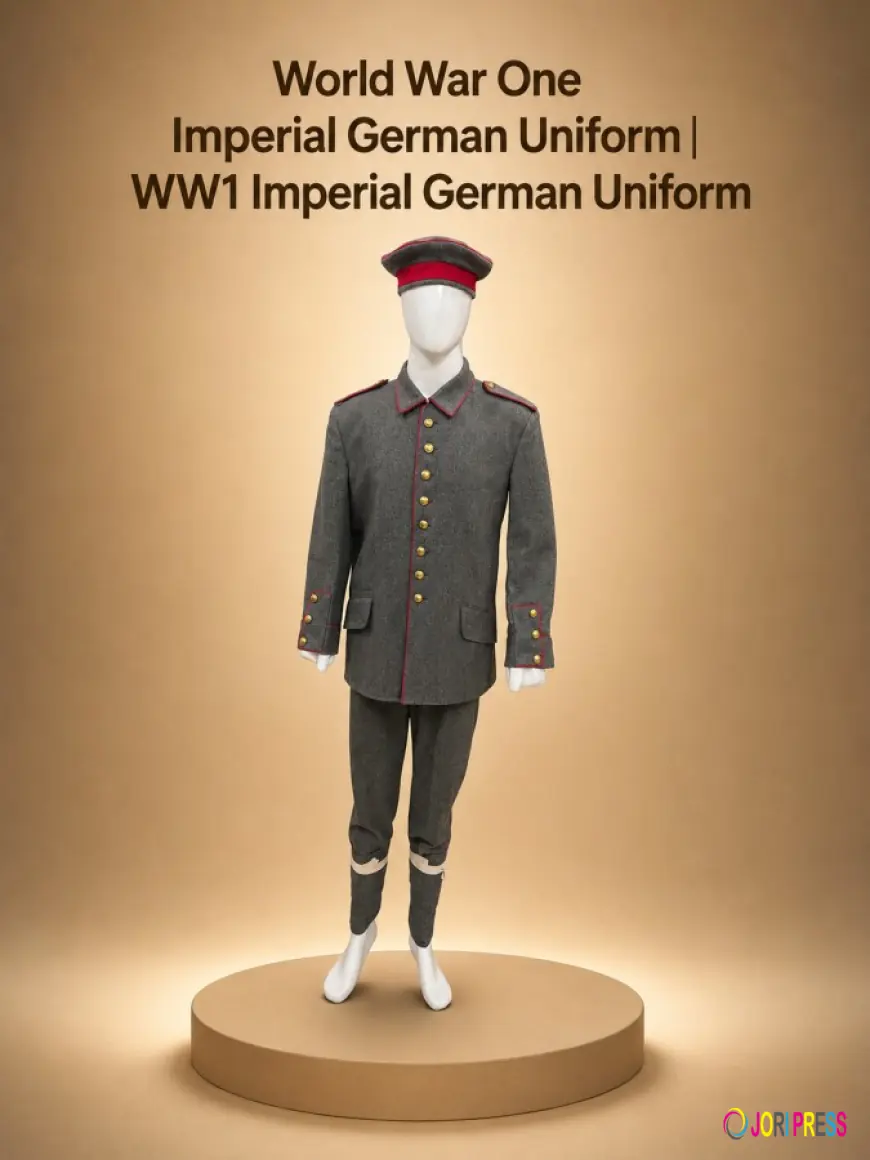
The material culture of the Imperial German Army during the Great War reflects a profound period of rapid industrial and tactical evolution. For modern living historians, theatrical directors, and dedicated military collectors, analyzing the structural shift in European combat garments is essential to creating accurate educational displays. To fully understand or accurately source a world war 1 german uniforms selection, enthusiasts must closely examine the transition from pre-war pageantry to the grim, utilitarian realities of trench warfare.
The Birth of the M1910 Feldgrau Uniform
When mobilization orders were declared in August 1914, German infantrymen marched to the fronts wearing the M1910 Feldgrau (Field Gray) uniform jacket. This design replaced the archaic, bright blue peacetime attire with a highly advanced, mathematically calculated shade of greenish-gray designed to blend effectively into continental European landscapes.
The M1910 tunic featured distinctive piping along the front closure, cuffs, and pocket flaps—with colors corresponding to specific army corps or regions, such as Prussia, Bavaria, or Saxony. The uniform relied on a robust, dense wool blend to endure cold climates, accompanied by solid brass or crown-embossed tombac buttons. True historical presentation relies heavily on replicating these distinct regional variations and heavy textile weights accurately.
The Grim Evolution: The 1915 and 1916 Bluse
As industrial blockades tightened and battlefields faced unprecedented modernization, the high costs and production times of the M1910 pattern forced significant design overhauls. This shift led to the introduction of the M1915 Feldrock and, ultimately, the iconic M1916 Bluse.
The M1916 Bluse represented total adaptation to industrial warfare:
-
Concealed Closures: Brilliant brass buttons were completely covered by a clean wool placket to avoid glare under flare light.
-
Deep Turnback Cuffs: Cuffs were simplified to streamline factory assembly lines.
-
Deep Green Collars: The standing collar was swapped for a soft, dark reseda-green or field-gray fold-back collar.
For historical societies aiming to showcase specific late-war campaigns—such as the Somme or the Spring Offensives of 1918—identifying a vendor capable of executing a structurally sound ww1 german uniform reproduction is non-negotiable. Modern theatrical costuming often uses light synthetic materials that lack the correct drape and raw aesthetic durability necessary for authentic living history.
Achieving Archival Precision with ReplicaMilitary
Achieving museum-grade fidelity requires working with producers who reverse-engineer original battlefield relics. From the exact count of interior cotton drill reinforcement linings to the correct spacing of the belt-support hooks (Koppelknechte), every stitch matters.
As a premier specialized historical outfitter, ReplicaMilitary focuses exactly on these micro-details. By maintaining strict allegiance to historical tailoring guidelines, their workshop bridges the gap between historical blueprints and active field use. Their tailored patterns ensure that when full leather webbing, cartridge pouches, and heavy equipment are secured, the uniform retains its authentic, rugged historical silhouette without buckling.
What's Your Reaction?
 Like
0
Like
0
 Dislike
0
Dislike
0
 Love
0
Love
0
 Funny
0
Funny
0
 Angry
0
Angry
0
 Sad
0
Sad
0
 Wow
0
Wow
0