







































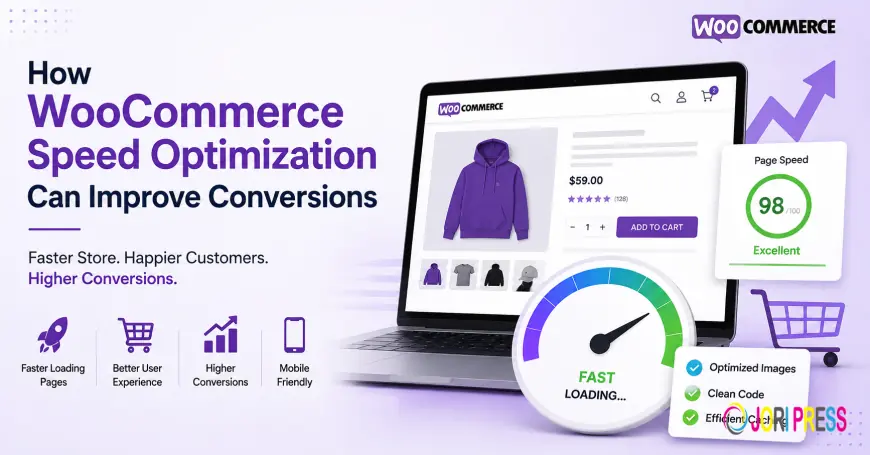
How WooCommerce Speed Optimization Can Improve Conversions
Learn how WooCommerce speed optimization improves user experience, reduces friction, boosts conversions, and creates a faster, more effective ecommerce store.
A customer comes to an online store with a product in mind. They click a category, go to a product page, sit back and wait.
And wait.
Eventually, the page loads, but by then, the customer is wondering whether or not the purchase was worth it. They exit the site, go to another store, and do shopping elsewhere.
This situation occurs far more frequently than many ecommerce businesses are aware of.
Speed is more than just a technical indicator for a WooCommerce store. It's an integral part of the customer experience and customer experience is directly linked to conversions. A business which is quick and responsive makes shopping feel easy. A slow store adds up friction in the buying experience.
This is why WooCommerce Speed Optimization is not just a technical upgrade for developers but an integral element of ecommerce growth.
Why Store Speed Matters to Customers
Internet consumers are now used to immediate digital experiences. They want products to load fast, filters to respond instantly, and the checkout process to be hassle-free, with no unexpected delays.
A slow response doesn't necessarily mean a customer thinks, "This website is slow to respond.
All they do is say, “I’ll just look around instead.”
That distinction matters.
A slow site might have an impact on product discovery, engagement, add to cart, and checkout completion without you realizing. However, customers who are interested in a product might drop out of the purchase process if there is too much friction on a website.
For many ecommerce companies, every second counts.
The Connection Between Speed and Conversion
Conversion occurs when a visitor performs a valuable action, typically buying a product, but also other valuable actions such as subscribing, requesting information, or adding a product to a cart.
Speed affects the ease of navigating towards that action.
Assume there are two shops offering the same product. Store A is fast to load, fast to respond, and allows customers to navigate to the next page without any hindrances. While customers are looking for products on Store B, the product images take several seconds to load, and even more time when the customers start applying filters. Store B becomes slow during checkout.
It might be that Store A offers the same products or prices as Store B, but the shopping experience feels easier at Store A.
This is where performance becomes a business issue.
A faster site means that there is less friction between customer intent and customer action. Ensuring the seamless movement of visitors to find products, view information and make a purchase without interruptions creates a natural route to conversion.
What Makes a WooCommerce Store Slow?
As WooCommerce stores expand, they can slow down.
A new store can start out with a light theme, a small number of products, and few plugins. As companies grow over time, they start incorporating payment gateways, marketing, analytics, product filters, reviews, shipping integrations, subscriptions, security systems, etc.As businesses grow, they begin to include payment gateways, marketing, analytics, product filters, reviews, shipping integrations, subscriptions, security systems, etc.
Every addition may add another aspect of performance to consider.
Another frequent problem is large image files. Product photos are crucial for ecommerce, but poorly optimized images can lead to a heavy page weight.
Other factors that can make for sluggish experiences are database overhead, inefficient code, too many plugin requests, third-party scripts, bad hosting, and insufficient caching.
It's a challenge because it's not always the best to remove useful functionality.
The goal is to improve the operation of the current business.
Product Pages Deserve Special Attention
One of the most essential pages of an ecommerce website are product pages.
They respond to the questions, show the product, gain the customer's confidence and finally push him towards buying.
The effect these pages can have if they take longer to load can be quite profound.
The product gallery may not be viewed by a customer. They might not get to reviews or specifications. They might never even manage to get to the add to cart button.
Speed optimization should take into account the entire product experience.
Images to be compressed and presented in modern image formats (where applicable). Unnecessary scripts should be minimised and essential content should load quickly. Customers should be able to interact with the page's elements (such as the galleries, variations, reviews, etc.) without affecting the page's responsiveness.
The aim of that is not just a higher speed score.
The aim is to enhance the customer's shopping experience.
Checkout Speed Can Make or Break a Sale
If a customer gets to the checkout, they've already shown high intent to purchase.
This is why the checkout performance is especially critical.
Now picture the situation when you spend a few minutes browsing the products and then have to wait minutes to get to the checkout page.Now visualize people spending a few minutes looking at the products and then waiting minutes at the checkout page. It takes time for payment fields to react. Shipping calculations are not shown until the late night. Payment gateway is slow to load.
This is where a little glitch can convert a finished order into a cart that is left behind.
Improving checkout isn't just about getting the page to load faster. Technical issues like unnecessary scripts, third-party integrations, database queries, payment processes, and more can cause delays, so it's time for businesses to review them.
The checkout process should be smooth and the last and easiest step in the customer's journey.
Mobile Performance Is No Longer Optional
A significant amount of traffic for ecommerce companies is from mobile.
Mobile shoppers also may have a lower-speed network connection or less capable devices than desktop shoppers. What looks good on a high speed desktop may leave the user frustrated on a cell phone.
This is why mobile performance is essential to consider when optimizing WooCommerce.
Mobile-friendly page design, optimized images, faster code, fewer JavaScripts, browser caching, and optimized page structure all enhance mobile experience.
The important question isn't simply, "Does the website work on mobile?"
It is:
“Is it easy and quick to navigate the site on mobile?”
Speed Optimization Is More Than a Technical Score
Performance metrics can be very useful tools, but ecommerce companies should not focus solely on them.
The technical score is possible to achieve, but it does not necessarily provide a good customer experience. On the other hand, a minor enhancement that significantly improves the usability of the products browsing can be worth a great deal in terms of business.
The most effective method is to use technical performance data along with customer behaviour.
Organizations can explore areas where users exit, most visited pages, dwell time on product pages, cart abandonment, and the differences between mobile and desktop users.
This learning enables the identification of those areas of performance that most likely will affect revenue.
A Practical Approach to WooCommerce Speed Optimization
The first and most important step in effective optimization is an audit and not any website changes.
The stores's hosting environment, theme, plugins, database, images, scripts, coding and caching configuration, CDN setup and third-party services should be checked.
After identifying these most significant bottlenecks, changes can be prioritised according to their potential.
The repeated processing of servers may be minimized with caching. CDNs may be able to support the delivery of assets closer to consumers. Optimizing the database can eliminate unnecessary queries and optimizing the images can make product pages much lighter.
It's also vital for plugin management. If it doesn't need to be removed just because it exists, it should be carefully considered if it's not being used or is not working efficiently.
This should be an ongoing process and not a project.
Faster Stores Create Better Business Opportunities
There is no complicated correlation between speed and conversions.
Customers like to make frictionless purchases.
Quick response pages makes product discovery easier. With fast product page load time, customers can make decisions quickly. If the checkout process is seamless, there is less friction between intent and purchase.
It does not necessarily mean that more is sold if it is sold quickly. The conversion rates are impacted by pricing, product quality, trust, branding, customer service, and marketing.
However, a slow website can deteriorate them all.
If the customer doesn't see it before they leave, then a great product cannot convert. If the checkout is broken, then the strong offer is worthless. If the landing page isn't able to provide a quick experience, then an effective marketing campaign becomes worthless.
Thus, for WooCommerce enterprises with the mission of keeping on growing, WooCommerce Speed Optimisation ought to be considered as an investment in the overall client journey.
The goal isn't just about making a web site run faster.
It's to help with the purchasing process.
When customers can make the journey from discovery to decision to checkout without any unnecessary towing, a slower WooCommerce store can be a real competitive edge in this very competitive ecommerce landscape.
What's Your Reaction?
 Like
0
Like
0
 Dislike
0
Dislike
0
 Love
0
Love
0
 Funny
0
Funny
0
 Angry
0
Angry
0
 Sad
0
Sad
0
 Wow
0
Wow
0