




































Uganda launches review process of MSME and National Standards & Quality policies.

Through the Ministry of Trade, Industry and Cooperatives, Uganda has launch of the review of Uganda’s two critical policies – the Micro, Small and Medium Enterprises (MSME) Policy and the National Standards & Quality Policy aimed t boosting SMES growth and competitiveness respectively.
Also stakeholders launched the good governance guide for Uganda's quality infrastructure institutions.
The launch held in Tuesday 2nd December 2025 at Four Points by Sheraton hotel was co-hosted by GAIN Uganda.
Due to various economic, and structure changes that have taken place since the policies were developed 10 years ago, the experts say that there are gaps and adjustments that need to be addressed.
The National Standards & Quality Policy was developed in 2012 to improve the competitiveness of Uganda's products, services & processes in domestic & international markets, & creating a strong regulatory framework for Standards, metrology& conformity assessment.
Meanwhile, the National MSME Policy was developed in 2015 with the purpose of stimulating the growth of MSMEs by enhancing their competitiveness and productivity, increase access to finance & business skills and expand market access tofor MSMEs.
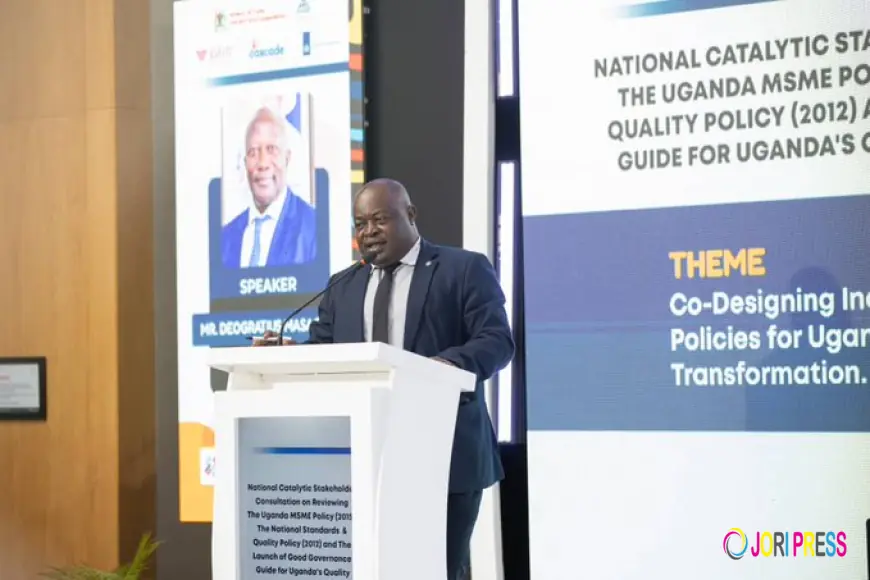
The National Catalytic Stakeholder Consultation on the Review of the Uganda MSME Policy (2015) and the National Standards and Quality Policy (2012) was themed: “Co-Designing Inclusive and Demand-Driven Policies for Uganda’s Tenfold Growth Transformation”
Achieving Uganda’s USD 500 billion economy by 2040, as envisioned under the Tenfold Growth Strategy and National Development Plan IV (NDP IV). Both frameworks emphasize sustainable industrialization for inclusive growth, employment, and wealth creation.
However, according to Deogratious Masagazi the Under Secretary and Representative of the Trade Minister Gen Wilson Mbadi, the success of this economic transformation rests on the vibrancy, competitiveness, and quality orientation of the private sector—particularly Micro, Small, and Medium Enterprises (MSMEs) that he sais account for 98.8% of Uganda’s enterprises, contributung 75% of GDP, 77% of formal jobs, and generating over 80% of domestic revenue.
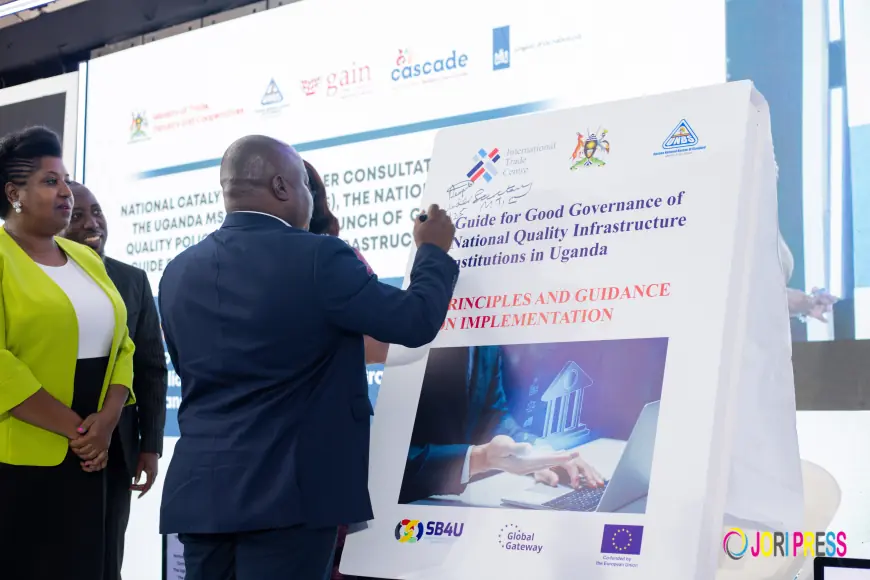
Deogratious signs to launch the review
The Under Secretary outlined the government’s commitment to strengthening MSME growth and national quality infrastructure.
“They are the backbone of Uganda’s economic fabric and the engine of future industrialization. Despite this importance, MSMEs face persistent challenges—limited access to finance, low productivity, weak innovation, and poor compliance with standards. Furthermore, the MSME Policy (2015) and the National Standards and Quality Policy (2012) have become outdated amid evolving national, regional, and continental priorities, including the AfCFTA, the EAC Industrialization Strategy (2021–2031), digital transformation, and sustainability imperatives” he said
The Ministry of Trade, Industry and Cooperatives (MTIC), through the Department of Business Development and Quality Assurance (BDQA), in partnership with the Global Alliance for Improved Nutrition (GAIN) Uganda, have championed the process to review the two policies.
The proposed National Catalytic Stakeholder Consultation represents a new model of participatory policymaking where the beneficiaries, implementers, and enablers of economic transformation jointly design the policies that drive Uganda’s growth.
The Commissioner, Business Development and Quality Assurance, Joram Patrick Mugisha at the Trade Ministry said that by contributing financially or in-kind, partners will not only support the modernization of Uganda’s enterprise and quality landscape but will also cement their role in shaping Uganda’s USD 500 billion future.
“Inclusive policymaking is smart policymaking. Together, let’s co-create the future of MSMEs and quality standards in Uganda,” he said

Damalie Ssali (L) and Sarah Kagingo
The Vice Chairman Private Sector Foundation of Uganda Sarah Kagingo while highlighling the key role of the privates sector especially SMMES said that as the review process goes on, there is a need to consider the risks pivoted technological advances, and governance of business to efficiently and intelligently.
Country Director GAIN Damalie Ssali said that addressing the policies is key to shaping actionable efforts and important to GAIN as a supporter of trade with food systems and standards especially with MSEMs.
Mr. James Kasigwa, Executive Director UNBS said that the review if the policies will enable transformation of the national quality infrastructure which he said includes : standardization, conformity assessment, meteorology, testing, accreditation among others.
What's Your Reaction?
 Like
0
Like
0
 Dislike
0
Dislike
0
 Love
0
Love
0
 Funny
0
Funny
0
 Angry
0
Angry
0
 Sad
0
Sad
0
 Wow
0
Wow
0