







































Silicon Carbide Power Semiconductor Market: EVs Drive Demand for Efficient Power
Explore Silicon Carbide Power Semiconductor Market forecasts to 2034, EV demand, device segments, regional opportunities, and the competitive landscape for SiC.
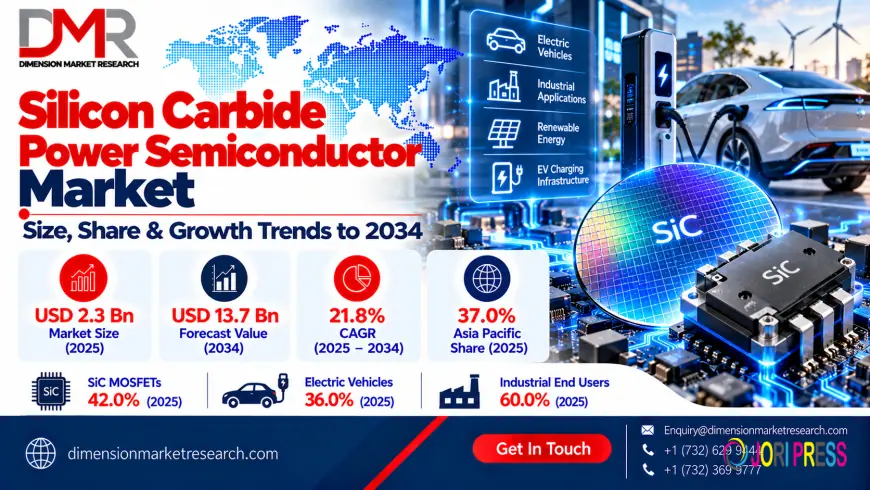
The Silicon Carbide Power Semiconductor Market is expanding alongside electric mobility and energy-efficient power systems. According to Dimension Market Research, the report projects USD 2.3 billion in 2025, reaching USD 13.7 billion by 2034, at 21.8% CAGR during 2025-2034.
For semiconductor suppliers, equipment manufacturers, and investors, this outlook raises an important strategic question: where can better power conversion create enough value to support a commercially attractive product?
Answering that question requires connecting technology choices with a specific application, customer requirement, and route to market. A broad growth forecast provides context, while a focused assessment helps businesses decide where to commit resources.
What Is the Silicon Carbide Power Semiconductor Market?
The market covers SiC-based power devices, including MOSFETs and Schottky diodes. These components support efficient operation at high voltages, temperatures, and switching frequencies.
For business readers, the useful distinction is between the component being purchased and the system it serves. A device specification becomes commercially meaningful when customers can connect it to their equipment requirements.
That suggests evaluating an opportunity from the application backward: establish what the customer needs to achieve, identify the relevant operating conditions, and assess how the proposed device contributes.
Which Segments Deserve Attention?
The report projects SiC MOSFETs at 42.0% of the device segment and electric vehicles at 36.0% of applications in 2025.
For suppliers, these findings suggest a useful starting point for customer research. However, segment size alone should not determine a product roadmap. Teams can investigate which requirements they are equipped to meet and where their capabilities offer a defensible advantage.
For an EV-focused business, practical questions include who influences component selection, what evidence customers require, and how a proposed offering fits their development process. A clear answer can help translate market interest into a realistic commercial plan.
Businesses considering multiple applications can compare opportunities using consistent criteria: customer fit, required investment, development resources, and the ability to support delivery. This approach makes competing proposals easier to assess.
Manufacturing Economics Matter
The report identifies high production costs and manufacturing constraints as barriers, while highlighting the transition toward 200mm SiC wafers.
For investors, this suggests examining the assumptions behind an expansion proposal. What level of output does the business expect? Which milestones must be reached before additional capacity becomes commercially useful? How would the plan perform if customer commitments develop more slowly than anticipated?
For procurement teams, the corresponding task is to test supplier claims against their own requirements. Discussions can address delivery commitments, continuity arrangements, and how the supplier intends to support the relationship.
These questions help make technology investment more concrete. They also encourage businesses to distinguish an attractive industry outlook from the execution requirements of an individual project.
Regional Opportunities and Competition
Asia Pacific is projected to lead with 37.0% of revenue in 2025. Companies covered include Wolfspeed, STMicroelectronics, Infineon Technologies, ROHM Semiconductor, and ON Semiconductor.
For regional planning, this suggests investigating where a company can reach relevant customers and provide effective support. A market’s scale is one input; the company’s ability to serve it is another.
Competitive assessment should similarly begin with a defined customer problem. Rather than comparing every supplier across every capability, businesses can identify the alternatives a prospective customer would actually consider.
For manufacturers, that exercise can sharpen positioning. For buyers, it can improve supplier discussions. For investors, it can reveal which assumptions about differentiation still require evidence.
Turning the Forecast Into a Business Decision
The most useful next step is to select one decision the research should inform: entering an application, prioritizing a geography, assessing a supplier, or evaluating a manufacturing investment.
Set the decision criteria before reviewing the findings. This makes it easier to identify relevant evidence and avoid treating every growth theme as equally important.
For strategy teams, a focused question might be: which opportunity best matches our capabilities and available resources? For procurement leaders, it might be: which supplier arrangement meets our operational requirements? A disciplined research process should help clarify those choices.
Frequently Asked Questions
1. What market value does the report project for 2025?
USD 2.3 billion.
2. What is the projected value by 2034?
USD 13.7 billion.
3. What CAGR does the report state?
21.8% during 2025-2034.
4. Which device segment is expected to lead?
SiC MOSFETs, with a projected 42.0% share in 2025.
5. Which region is expected to lead?
Asia Pacific, with a projected 37.0% revenue share in 2025.
Conclusion
The report presents a substantial expansion opportunity through 2034, with electric mobility supporting demand. For businesses, the practical priority is to connect that outlook with a focused application strategy, credible delivery capabilities, and clearly defined customer value.
What's Your Reaction?
 Like
0
 Dislike
0
 Love
0
 Funny
0
 Angry
0
 Sad
0
 Wow
0