



































Leadership After the AI Tools Arrive in the Job Market

Every technology era produces a managerial fantasy. This one is that AI will make decisions for us, cleanly, quickly, without politics or uncertainty.
Aditya warns against that fantasy repeatedly, in language that is almost plain to the point of severity. AI can deliver insights faster than humans, he acknowledges, but “there’s a catch” because AI systems are only as good as the data they are fed. And when the data is biased or incomplete, the system can perpetuate inequality and make poor decisions.
Leadership, in Aditya’s telling, is not diminished by AI. It is tested by it. In his chapter on AI and leadership, he writes that AI is now “a significant player in leadership and governance,” changing how decisions are made, how teams collaborate, and how strategies are formed. Understanding AI’s potential is “no longer optional,” he says.
That line can sound like the usual drumbeat, until he clarifies what “understanding” means: ethics, governance, transparency, accountability.
He argues for governance frameworks with guidelines for data management, decision-making, and accountability. He pushes for transparency, so decision-making can be explained and understood by humans. He highlights data privacy as a leadership responsibility, not an IT afterthought.
The book also confronts a quieter leadership failure: over-reliance. In a section explicitly titled “Avoiding Over-Reliance on AI,” Aditya warns that blindly following AI-generated insights can ignore societal impacts and erode accountability. He proposes a corrective that sounds modest but is radical in practice: treat AI insights as one of several inputs, combine them with human intuition and ethical judgment, and engage stakeholders beyond the executive suite.
This is the part of the book that reads most like a cultural critique. It suggests that organizations are not simply adopting a new tool. They are adopting a new relationship to responsibility. When AI systems become “strategic compasses,” as Aditya puts it, leadership has to decide how to hold the compass without surrendering the map.
The tension is not theoretical. Consider the ethical questions Aditya explores around dynamic pricing and predictive policing, areas where instant decisions can amplify inequality. Or the deepfake risk he describes, where manipulated content can damage reputations and enable fraud. These are not “future” problems. They are current leadership problems because they require policies, oversight, and clear lines of accountability.
Aditya’s best-case vision is not a company run by machines. It is a company where humans learn to collaborate with machines without relinquishing judgment. In a Nike case study, he argues that AI is not a replacement for human creativity or leadership, but “a powerful tool that enhances these qualities.” The lesson is not that AI makes leaders obsolete. It is that AI makes leadership harder to fake. It demands competence, not charisma.
To do this well, leaders must build cultures open to experimentation and continuous learning, and they must plan for change management, not stumble into it. They must also insist on explainability, designing systems that provide “clear, human-understandable explanations” for outputs.
In other words, they must make AI legible inside the organization, so it cannot become a black box that everyone fears and no one challenges.
The AI era will expose weak leadership faster than any previous technology wave, because it accelerates decision-making while raising the moral stakes. Leaders cannot delegate responsibility to a model. They can only decide, repeatedly, what kind of organization they are willing to become.
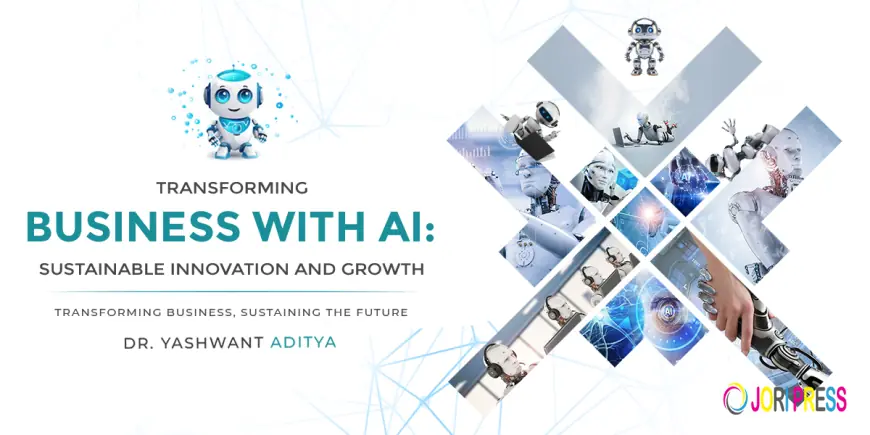
And that is why Transforming Business with AI is worth reading, not as a promise of disruption, but as a sober guide to the part most people skip: governance, accountability, and the disciplined human work of deciding what you will not automate.
What's Your Reaction?
 Like
1
Like
1
 Dislike
0
Dislike
0
 Love
0
Love
0
 Funny
0
Funny
0
 Angry
0
Angry
0
 Sad
0
Sad
0
 Wow
0
Wow
0