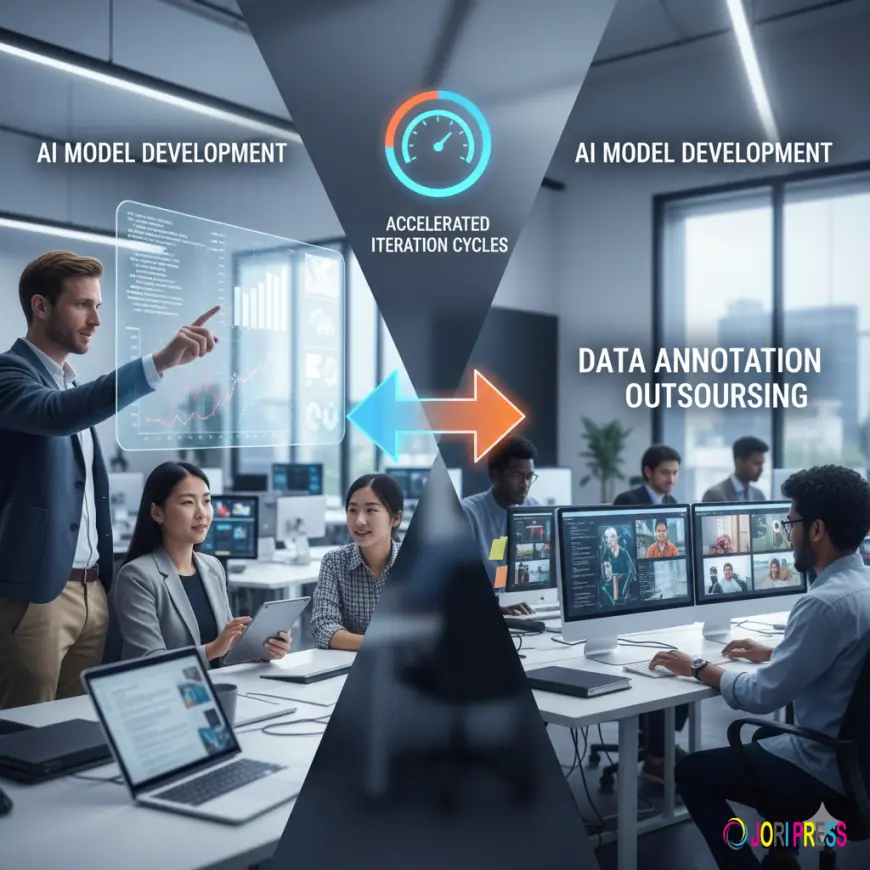
In today’s competitive AI landscape, speed matters as much as accuracy. Leading teams increasingly rely on strategic partnerships with a specialized data annotation company to compress iteration cycles, improve model performance, and maintain development velocity across pilots and production rollouts. When executed correctly, data annotation outsourcing becomes not just a cost lever but a force-multiplier for experimentation, governance, and sustained model improvement.
Why iteration speed is a strategic priority
Modern AI development is an iterative process: collect or generate data, label it, train models, evaluate performance, and repeat. Each cycle introduces new hypotheses, fresh data needs, and corrective actions. The time spent on high-quality labeling is often the gatekeeper for how quickly a team can test improvements. For teams aiming to deliver continuous improvements to classifiers, detectors, or generative models, annotation delays translate directly into slower feedback loops and missed opportunities.
Outsourcing data labeling to a proven vendor reduces this friction. A capable partner provides elastic capacity, domain-specialist annotators, and tooling that integrates with your pipelines — all of which shorten the turnaround time between hypothesis and validated result.
How top teams structure outsourcing to cut cycle time
Successful teams treat outsourced annotation as a tightly integrated service rather than a one-off transaction. Common patterns include:
-
Designing narrow, time-boxed annotation sprints. Teams break work into small, well-scoped batches aligned to specific experiments (e.g., “label 2,000 edge-case frames of occluded pedestrians”). Short sprints reduce feedback latency and lower rework when annotation instructions evolve.
-
Embedding shared QA and adjudication workflows. Rather than waiting until entire datasets are complete, teams instrument continual QA: spot checks, inter-annotator agreement metrics, and adjudication queues. This real-time quality control preserves iteration velocity because mislabeled data is caught early, not after training.
-
Using pilot labeling to refine guidelines. Before committing to large-scale annotation, teams run a small pilot with the outsourcing partner to validate guidelines, measure agreement, and calibrate edge-case rules. Pilots quickly expose ambiguities that would otherwise produce rework and slow subsequent cycles.
-
Automating handoffs with MLOps integration. Leading teams integrate annotation platforms with experiment tracking and model training pipelines so labeled data flows automatically into retraining jobs, enabling near-continuous redeployment.
Operational capabilities that matter
Not all vendors accelerate iteration cycles equally. AI teams look for specific capabilities when selecting a data annotation company:
-
Scalable, on-demand workforce. The ability to scale annotator headcount rapidly without sacrificing accuracy is key to shortening turnaround time.
-
Domain and language expertise. Specialists (medical coders, geospatial analysts, legal annotators) reduce the time to high-quality labels for complex tasks.
-
Robust QA and analytics. Dashboards showing agreement scores, label distributions, and per-annotator performance let teams identify issues quickly.
-
Flexible tooling and APIs. A vendor’s platform should support custom label types, active learning loops, and seamless API-based ingestion/extraction of datasets.
-
Security and compliance. Fast iteration is pointless if data cannot be shared safely; enterprise-grade security and contractual safeguards keep development moving on real data.
Practical workflows that compress the loop
Below are practical workflows that high-performing AI teams use to accelerate cycles with outsourced annotation:
1. Active learning + targeted outsourcing
Teams use model uncertainty to prioritize which samples are sent for human labeling. By outsourcing only the most informative examples, annotation budgets are used efficiently and retraining shows larger performance gains per cycle.
2. Hybrid human-in-the-loop pipelines
Automated pre-labeling (from a weak model or heuristic) reduces annotation time per sample. Human annotators then validate or correct these pre-labels. Outsourcing partners often provide templated workflows for pre-label verification, significantly cutting total labeling time.
3. Continuous small-batch delivery
Instead of monolithic datasets, annotators deliver frequent small batches (e.g., daily or twice-weekly). Continuous delivery enables teams to retrain on fresh data rapidly and shorten the time between discovery and validation.
4. Focused error analysis to drive labeling priorities
Model evaluation outputs (confusion matrices, per-class error rates) are fed back into the annotation partner to prioritize labeling where it will most improve the model. This targeted approach accelerates meaningful performance gains.
Measuring impact: metrics that matter
Organizations that treat annotation as a strategic capability measure its effectiveness against model-centric KPIs, including:
-
Time-to-labeled-sample: average elapsed time from sample request to usable labeled data.
-
Iteration frequency: number of retraining cycles per month or quarter.
-
Label quality: inter-annotator agreement (IAA) and post-adjudication correction rates.
-
Model uplift per batch: performance improvement (e.g., mAP, F1) attributable to the latest labeled data.
-
Cost per effective improvement: annotation spend divided by realized model performance gains.
Tracking these metrics lets teams quantify how a data annotation company contributes to development velocity and ROI.
Risk management and governance
Speed must be balanced with quality, privacy, and compliance. Leading teams insist on:
-
Clear SLAs for turnaround times and quality metrics.
-
Transparent audit trails for labeling decisions and adjudications.
-
Data minimization and redaction techniques for sensitive datasets.
-
Regular security reviews and adherence to industry standards.
These safeguards prevent rework and legal friction that can stall iteration cycles.
Real-world outcomes
Teams that adopt these practices report measurable benefits: 30–60% faster iteration cycles on average, higher model stability in production, and improved ability to experiment with advanced architectures. By converting annotation from a bottleneck into a repeatable capability, organizations reduce the calendar time between idea and impact.
Conclusion — make annotation a competitive advantage
In the race to build better AI, time is a competitive asset. Working with a specialized data annotation company enables leading teams to accelerate model iteration cycles through scalable capacity, targeted workflows, robust QA, and MLOps integration. When annotation is treated as a strategic partnership rather than an outsourced checkbox, it becomes a lever for continuous experimentation, faster learning, and superior model outcomes.
Annotera partners with AI teams to operationalize these practices: from pilot refinement and active-learning integrations to enterprise-ready security and analytics. If your team is ready to shorten iteration cycles and drive faster model improvements, contact Annotera to design a tailored annotation strategy that aligns with your development cadence and quality bar.









































 Like
0
Like
0
 Dislike
0
Dislike
0
 Love
0
Love
0
 Funny
0
Funny
0
 Angry
0
Angry
0
 Sad
0
Sad
0
 Wow
0
Wow
0