







































How Analytical Balance Suppliers Support Quality Control in Manufacturing
Analytical Balance Suppliers are key partners in maintaining strong quality control in manufacturing. High-precision balances ensure exact measurements, reduce errors, and help businesses meet strict regulatory standards.

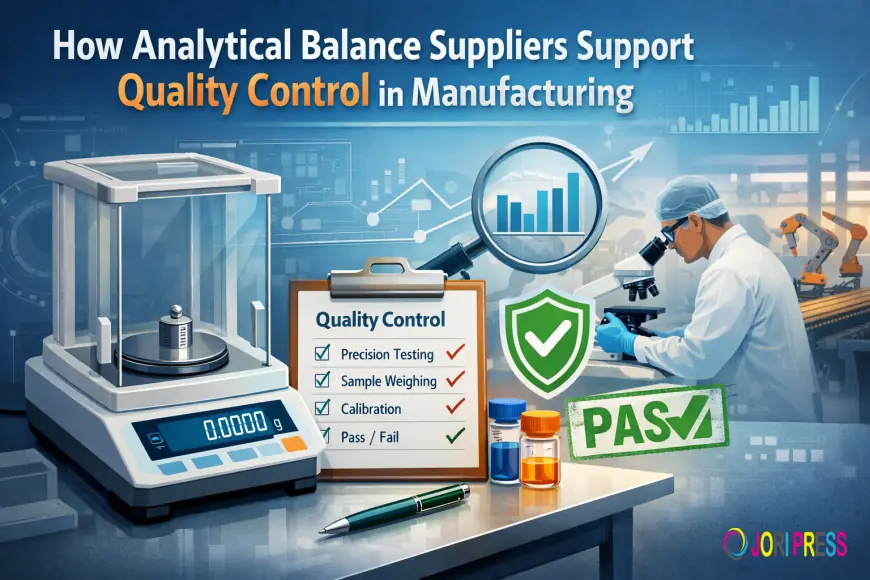
In manufacturing industries, quality control is not just a department—it is a system that safeguards product integrity, regulatory compliance, and brand reputation. Whether producing pharmaceuticals, chemicals, automotive components, electronics, or food products, manufacturers depend on accurate measurements to ensure consistency and reliability. Among the most critical tools in this process is the analytical balance.
Behind every accurate weighing result stands a dependable analytical balance supplier. These suppliers do far more than sell instruments; they enable quality control systems to function efficiently, accurately, and in compliance with industry standards. This blog explores in detail how analytical balance suppliers support quality control in manufacturing and why their role is indispensable.
The Importance of Accurate Weighing in Manufacturing Quality Control
Manufacturing quality control relies heavily on precise mass measurement at multiple stages of production. Even the smallest deviation in weight can affect product performance, safety, or compliance.
Analytical balances are commonly used for:
-
Verifying incoming raw materials
-
Measuring active ingredients and additives
-
Monitoring batch formulation accuracy
-
Conducting in-process quality checks
-
Validating finished products
Because these measurements influence final product quality, manufacturers must rely on analytical balance suppliers who deliver accuracy, stability, and long-term performance.
1. Providing High-Precision Instruments for Critical Measurements
One of the most important contributions analytical balance suppliers make to quality control is providing high-accuracy weighing instruments that meet industrial demands.
Trusted suppliers ensure that balances:
-
Offer high readability (often 0.1 mg or better)
-
Maintain accuracy across repeated measurements
-
Perform reliably under continuous laboratory use
In quality control labs, repeatability is essential. A reputable supplier ensures that the analytical balance produces consistent results across shifts, operators, and production batches—helping manufacturers detect variations before they become costly defects.
2. Supporting Compliance with Manufacturing Standards and Regulations
Manufacturing industries are governed by strict regulatory frameworks such as ISO 9001, ISO 17025, GMP, GLP, and industry-specific guidelines. Analytical balance suppliers play a critical role in helping manufacturers comply with these standards.
Suppliers support compliance by:
-
Offering balances suitable for regulated environments
-
Providing validation-ready instruments
-
Ensuring compatibility with traceable calibration standards
By working with knowledgeable suppliers, manufacturers reduce audit risks and ensure that weighing processes meet regulatory expectations at all times.
3. Enabling Accurate Calibration and Measurement Traceability
Calibration is a cornerstone of quality control. Even the most advanced analytical balance can produce unreliable data if it is not properly calibrated. Analytical balance suppliers support QC teams by offering:
-
Guidance on internal and external calibration methods
-
Access to calibration weights and services
-
Recommendations for calibration frequency
This ensures traceability of measurements to recognized standards, which is essential for audits, certifications, and process validation in manufacturing environments.
4. Improving Process Control and Batch Consistency
Consistency across production batches is a key objective in quality control. Analytical balance suppliers help manufacturers achieve this by providing instruments with advanced features such as:
-
Fast stabilization time
-
Environmental compensation for temperature and vibration
-
High repeatability under varying conditions
Suppliers also assist QC teams in selecting the correct balance capacity and sensitivity, ensuring accurate measurements without overloading or underutilizing the instrument.
5. Delivering Industry-Specific Weighing Solutions
Different manufacturing sectors have unique quality control requirements. Experienced analytical balance suppliers understand these differences and offer application-specific recommendations.
Examples include:
-
Pharmaceutical manufacturing: Precision weighing of APIs and excipients
-
Chemical manufacturing: Resistance to corrosive substances
-
Food processing: Reliable weighing for routine QC testing
-
Electronics manufacturing: Micro-weighing of small components
This tailored approach ensures that quality control teams use the most suitable equipment for their processes, improving accuracy and efficiency.
6. Minimizing Downtime Through Technical Support and Service
Unplanned downtime in quality control labs can disrupt production schedules and delay product release. Analytical balance suppliers support manufacturing operations by providing:
-
Prompt technical assistance
-
Preventive maintenance recommendations
-
Access to replacement parts or service support
Reliable after-sales service ensures that balances remain operational and quality control workflows continue without interruption.
7. Enhancing Data Integrity and Digital Integration
Modern manufacturing quality control depends on accurate data recording and traceability. Many analytical balance suppliers offer instruments with advanced digital capabilities, including:
-
Data output via USB or network connectivity
-
Integration with Laboratory Information Management Systems (LIMS)
-
Secure data logging to reduce human error
These features help QC teams maintain data integrity, simplify documentation, and strengthen compliance with regulatory requirements.
8. Supporting Cost Efficiency and Long-Term Investment Value
Analytical balances represent a long-term investment in quality control infrastructure. Analytical balance suppliers help manufacturers optimize costs by:
-
Offering a range of models at different price points
-
Preventing over-specification of instruments
-
Recommending durable, low-maintenance designs
This approach ensures manufacturers achieve reliable quality control without unnecessary expenditure, contributing to sustainable operations.
9. Training and Knowledge Support for Quality Control Teams
Human factors play a significant role in measurement accuracy. Some analytical balance suppliers provide training resources and technical guidance to help QC personnel:
-
Use balances correctly
-
Avoid common weighing errors
-
Understand best practices for sample handling
Well-trained operators produce more reliable data, directly strengthening manufacturing quality control systems.
Why Analytical Balance Suppliers Are Strategic Quality Partners
In manufacturing, analytical balance suppliers are not just vendors—they are strategic partners in quality assurance. Their expertise in instrumentation, compliance, calibration, and application support directly impacts the accuracy and reliability of quality control processes.
Platforms like LabAtoZ make it easier for manufacturers to connect with trusted analytical balance suppliers, compare specifications, and choose instruments that align with their quality control requirements.
Conclusion
Analytical balance suppliers play a vital role in supporting quality control across manufacturing industries. By delivering precision instruments, regulatory support, calibration guidance, technical service, and application expertise, they help manufacturers maintain consistent quality, meet compliance standards, and improve operational efficiency.
As manufacturing quality requirements become increasingly stringent, partnering with the right analytical balance supplier is essential for long-term success.
What's Your Reaction?
 Like
0
Like
0
 Dislike
0
Dislike
0
 Love
0
Love
0
 Funny
0
Funny
0
 Angry
0
Angry
0
 Sad
0
Sad
0
 Wow
0
Wow
0