





































How AI Is Supporting Clinical Trial Operations Without Replacing Human Expertise
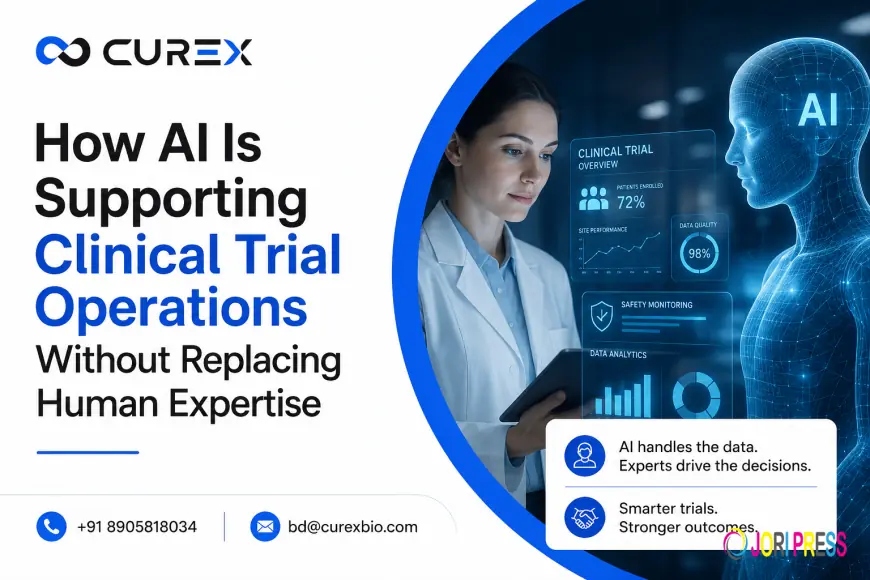
Artificial Intelligence (AI) is rapidly transforming industries across the globe, and clinical research is no exception. From accelerating patient recruitment to improving data management and streamlining regulatory documentation, AI is helping sponsors and Clinical Research Organizations (CROs) optimize clinical trial operations.
Despite the excitement surrounding AI, one misconception continues to circulate—that AI will replace clinical researchers, physicians, clinical research associates (CRAs), data managers, medical writers, and regulatory professionals. In reality, AI is best viewed as a powerful tool that supports human expertise rather than replacing it.
Clinical trials involve scientific judgment, ethical decision-making, regulatory compliance, patient safety, and multidisciplinary collaboration—areas where human experience and critical thinking remain indispensable. AI enhances these processes by automating repetitive tasks, analyzing large datasets, and providing actionable insights, allowing clinical professionals to focus on higher-value activities.
In this article, we explore how AI is supporting clinical trial operations while reinforcing the essential role of human expertise.
The Growing Role of AI in Clinical Research
Clinical trials generate enormous volumes of data from multiple sources, including:
- Electronic Data Capture (EDC) systems
- Electronic Health Records (EHRs)
- Laboratory reports
- Medical imaging
- Wearable devices
- Electronic Patient-Reported Outcomes (ePRO)
- Pharmacovigilance databases
Managing this information efficiently is increasingly challenging. AI-powered technologies help process and analyze these datasets more quickly, enabling research teams to identify trends, detect anomalies, and make informed decisions faster.
Rather than replacing professionals, AI acts as an intelligent assistant that improves productivity and operational efficiency.
Why Human Expertise Remains Essential
Clinical research extends far beyond data analysis. Every clinical trial requires professionals who can:
- Interpret complex scientific information
- Evaluate patient safety risks
- Apply ethical principles
- Communicate with investigators and participants
- Understand evolving regulatory requirements
- Make decisions based on medical judgment
- Respond to unexpected clinical situations
AI can generate recommendations, but it cannot replace the accountability, empathy, and contextual understanding that experienced clinical professionals bring to a trial.
How AI Is Supporting Clinical Trial Operations
1. Accelerating Patient Recruitment
Recruiting eligible participants is one of the biggest challenges in clinical research.
AI can assist by:
- Screening large healthcare datasets
- Identifying potential participants based on inclusion and exclusion criteria
- Predicting recruitment trends
- Identifying sites with strong enrollment potential
However, investigators and study coordinators remain responsible for confirming eligibility, obtaining informed consent, and ensuring participant safety.
Human Expertise Matters
Clinical professionals evaluate each participant individually and determine whether enrollment is appropriate based on medical judgment.
2. Improving Clinical Data Management
Modern clinical trials generate millions of data points throughout the study lifecycle.
AI supports Clinical Data Management by:
- Detecting missing data
- Identifying unusual patterns
- Flagging inconsistencies
- Prioritizing data queries
- Supporting data cleaning activities
This enables data managers to focus on reviewing critical issues instead of manually searching for errors.
Human Expertise Matters
Clinical data managers validate AI-generated findings, resolve discrepancies, and ensure that data meets regulatory and quality standards.
3. Supporting Risk-Based Monitoring
Traditional monitoring often requires frequent on-site visits and manual review of source documents.
AI enhances Risk-Based Monitoring (RBM) by:
- Identifying high-risk sites
- Detecting unusual data trends
- Monitoring Key Risk Indicators (KRIs)
- Highlighting protocol deviations
- Supporting centralized monitoring
This allows monitoring teams to prioritize their efforts where they are needed most.
Human Expertise Matters
Clinical Research Associates (CRAs) investigate AI-generated alerts, communicate with sites, and determine appropriate corrective actions.
4. Enhancing Protocol Design
Developing an effective clinical trial protocol requires balancing scientific objectives with operational feasibility.
AI can analyze historical trial data to:
- Predict recruitment timelines
- Identify common protocol amendments
- Recommend study design improvements
- Highlight potential operational challenges
These insights help sponsors develop more efficient protocols.
Human Expertise Matters
Medical experts, statisticians, and investigators make the final decisions regarding study design based on scientific, clinical, and regulatory considerations.
5. Supporting Regulatory Documentation
Preparing regulatory documentation is often time-consuming.
AI can assist with:
- Organizing source information
- Summarizing structured datasets
- Drafting initial document sections
- Identifying inconsistencies
- Improving document consistency
Examples include:
- Clinical Study Reports (CSRs)
- Investigator brochures
- Safety summaries
- Regulatory submission documents
Human Expertise Matters
Medical writers and regulatory affairs professionals review, edit, validate, and approve all documentation to ensure scientific accuracy and compliance.
6. Improving Safety Monitoring
Patient safety remains the highest priority in every clinical trial.
AI supports pharmacovigilance by:
- Identifying potential safety signals
- Detecting adverse event trends
- Prioritizing case reviews
- Monitoring large safety databases
Early identification of potential risks enables faster investigation.
Human Expertise Matters
Safety physicians and pharmacovigilance specialists determine the clinical significance of AI-generated signals and make decisions regarding patient safety.
7. Optimizing Clinical Trial Operations
AI provides valuable operational insights by analyzing study performance metrics.
Applications include:
- Predicting enrollment delays
- Forecasting resource requirements
- Monitoring site performance
- Identifying workflow bottlenecks
- Improving project planning
These insights help sponsors allocate resources more effectively.
Human Expertise Matters
Project managers evaluate recommendations within the broader context of trial objectives, budgets, and operational constraints.
Benefits of AI in Clinical Trial Operations
When implemented responsibly, AI offers several advantages:
Increased Operational Efficiency
Automation reduces repetitive administrative tasks, allowing teams to focus on strategic and scientific activities.
Better Data Quality
AI helps identify inconsistencies earlier, improving the reliability of clinical trial data.
Faster Decision-Making
Rapid analysis of large datasets supports timely operational and clinical decisions.
Enhanced Risk Management
AI-driven analytics help identify emerging risks before they affect study outcomes.
Improved Patient Experience
More efficient recruitment, scheduling, and communication contribute to a better participant experience.
Limitations of AI in Clinical Research
Despite its benefits, AI has important limitations.
AI cannot:
- Replace physician judgment
- Conduct informed consent discussions
- Build trust with participants
- Interpret complex ethical issues
- Make independent regulatory decisions
- Replace investigator oversight
- Accept legal responsibility for trial conduct
Clinical research requires accountability and human oversight at every stage.
Responsible AI Adoption in Clinical Trials
To maximize the benefits of AI, organizations should:
- Validate AI tools before implementation
- Maintain human oversight for all critical decisions
- Protect patient privacy and data security
- Monitor AI performance continuously
- Ensure transparency in AI-supported processes
- Train staff on responsible AI use
- Comply with applicable regulatory guidance
AI should be integrated into existing quality management systems rather than treated as a standalone solution.
The Future of AI and Human Collaboration
The future of clinical research is not about AI replacing people—it is about AI augmenting human expertise.
As technology continues to evolve, clinical professionals will increasingly work alongside AI to:
- Improve operational efficiency
- Enhance data quality
- Accelerate study timelines
- Strengthen regulatory compliance
- Support patient-centric clinical research
Organizations that successfully combine advanced technology with experienced clinical teams will be better positioned to conduct efficient, high-quality clinical trials.
How Curexbio Supports Technology-Driven Clinical Development
At Curexbio, we believe that innovation delivers the greatest value when combined with scientific expertise and rigorous quality standards.
Our comprehensive clinical research services include:
- Clinical Development Services
- Clinical Monitoring
- Clinical Data Management
- Biostatistics
- Medical Writing
- Pharmacovigilance
- Regulatory Affairs
- Clinical Quality Compliance
- Clinical Site Management
We leverage modern technologies and data-driven methodologies while ensuring that every critical clinical, scientific, and regulatory decision remains guided by experienced professionals. This balanced approach enables sponsors to improve efficiency without compromising patient safety, data integrity, or regulatory compliance.
Conclusion
Artificial Intelligence is reshaping clinical trial operations by automating routine tasks, improving data analysis, and supporting more informed decision-making. However, the success of clinical research still depends on the expertise of physicians, researchers, data managers, regulatory specialists, and quality professionals.
Rather than replacing human expertise, AI serves as a powerful enabler—helping clinical teams work more efficiently while allowing them to focus on the complex decisions that require scientific knowledge, ethical judgment, and patient-centered care.
As the clinical research landscape continues to evolve, organizations that combine advanced AI capabilities with experienced clinical professionals will be best positioned to deliver safe, efficient, and successful clinical trials.
Partner with Curexbio
Looking for a trusted CRO that combines innovative technologies with expert clinical leadership?
Curexbio provides end-to-end clinical development, clinical monitoring, clinical data management, pharmacovigilance, regulatory affairs, and quality compliance services to help sponsors conduct efficient, compliant, and patient-focused clinical trials. Contact our team today to learn how we can support your next clinical research program.
What's Your Reaction?
Like
0
Dislike
0
Love
0
Funny
0
Angry
0
Sad
0
Wow
0