











































Homomorphic Encryption Market Grows as Businesses Analyze Encrypted Data
The Homomorphic Encryption Market is forecast to reach USD 445.2 million by 2034. Explore encrypted analytics, adoption barriers and regional demand.
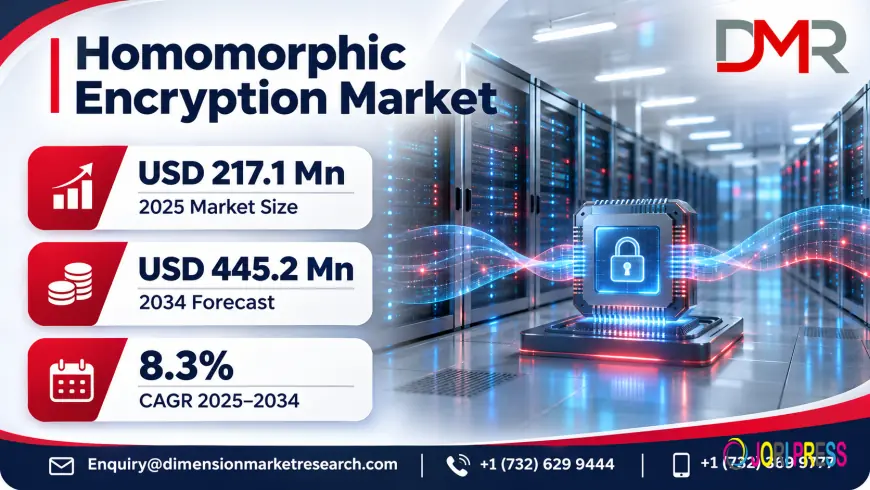
According to Dimension Market Research, the global Homomorphic Encryption Market was estimated at USD 217.1 million in 2025 and is projected to reach USD 445.2 million by 2034, at a compound annual growth rate of 8.3%. The technology addresses a practical problem for organizations that want to analyze sensitive information while limiting who can see the underlying records.
That capability is relevant when data owners and computing providers are separate organizations. A research institution, for example, may want to use external computing resources to analyze sensitive records. Homomorphic encryption allows the provider to perform supported calculations on encrypted inputs. The result can then be decrypted by an authorized party, subject to the system’s key management and access arrangements.
What Is the Homomorphic Encryption Market?
Homomorphic encryption allows computations on encrypted data. Some schemes support a limited set of operations, while fully homomorphic encryption (FHE) supports general computation on encrypted inputs. The distinction matters commercially because a buyer with a narrowly defined calculation may have different performance and integration requirements from one that needs to support several kinds of analysis.
Sensitive Analytics Gives Buyers a Defined Use Case
The report highlights privacy-preserving research as an application. Healthcare research illustrates the commercial need: an organization may want an outside party to run an agreed analysis while keeping identifiable source records encrypted. For suppliers, the opportunity is to show how their product fits the complete workflow, from preparing inputs to determining who can read the final result.
A narrowly scoped workload makes the buying decision easier to evaluate. An organization can specify the calculation it needs, the amount of data it expects to process and how quickly it needs an answer. It can then test whether the system meets those requirements at an acceptable cost. A recurring analysis with predictable inputs presents a different implementation challenge from an interactive service with variable requests and tight response times.
Performance and Integration Shape Adoption
Computational overhead is a commercial constraint. Processing encrypted inputs can require more time and computing resources, so buyers have reason to assess performance on their own workloads. A calculation that runs within the available window for a scheduled report may be too slow for an application that needs an immediate response. Comparing those requirements early helps buyers identify where deployment is practical.
Integration also affects the business case. An enterprise may need to connect the technology to existing data pipelines, define how keys are managed and establish how authorized users receive results. For vendors, that creates room to compete on deployment support and compatibility alongside cryptographic capabilities. Buyers can assess those factors by examining the effort required to move a pilot into routine use.
North America Leads as Large and Specialized Vendors Compete
DMR estimates that North America accounted for 39.2% of global revenue in 2025, the largest regional share. The report puts the US market at USD 71.6 million in 2025 and projects it to reach USD 140.7 million by 2034. It also provides outlooks for Europe and Japan.
Companies covered include Microsoft, IBM, Google, Intel, Thales, Duality Technologies, Zama and Enveil. The mix of large technology companies and specialist providers gives buyers several approaches to evaluate. A company comparing offerings can examine which computations each product supports, how it integrates with existing systems and what resources it requires at the expected scale.
Frequently Asked Questions
1. How large is the Homomorphic Encryption Market?
DMR estimates global revenue at USD 217.1 million in 2025 and projects it to reach USD 445.2 million by 2034.
2. What is the projected market CAGR?
The report projects an 8.3% CAGR from 2025 to 2034.
3. Which region leads the market?
North America leads, with an estimated 39.2% share of global revenue in 2025.
4. What does fully homomorphic encryption do?
It supports general computation on encrypted inputs. The computation produces an encrypted result that an authorized party can decrypt.
5. Where can organizations use homomorphic encryption?
The report identifies privacy-preserving analysis of sensitive research data as one application.
Conclusion
The opportunity through 2034 is strongest where an organization has a defined analytical task and a clear reason to keep its inputs encrypted during processing. For suppliers, demonstrating that a workload meets the buyer’s requirements for turnaround time, computing cost and integration can help turn a privacy requirement into a deployment decision.
Related Data Privacy and Cryptography Market Insights
The Privacy Enhancing Technologies Market Size report covers the broader market for tools that help organizations use sensitive data while limiting exposure.
The Confidential Computing Market Share report examines protection for data in use and estimates global revenue at USD 15.6 billion in 2026.
The Post-Quantum Cryptography (PQC) Market Growth report tracks adoption of quantum-resistant cryptography and projects global revenue of USD 21,272.4 million by 2034.
What's Your Reaction?
 Like
0
 Dislike
0
 Love
0
 Funny
0
 Angry
0
 Sad
0
 Wow
0