




































Gov’t Releases UGX. 16.5 Tn for expenditure limits in January to March 2026 quarter.

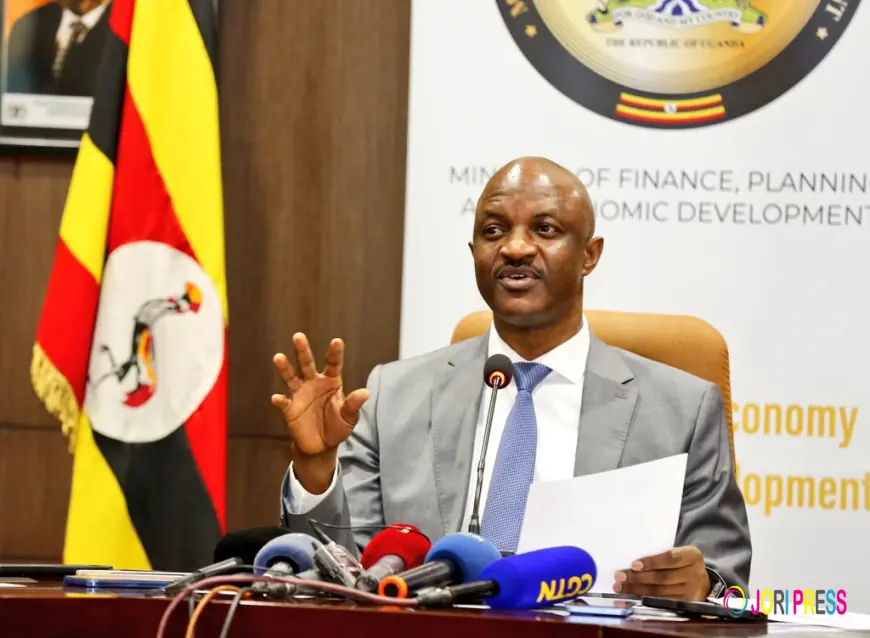
Government through the Ministry of Finance, Planning and Economic Development released Shs16.537 trillion ($4.4 billion) for January to March, prioritizing debt servicing at Shs7.59 trillion, wages, security, and growth areas like infrastructure and energy among others.
While making his remarks during the Quarter Three Press Briefing for the Financial Year 2025/26 held at the ministry building in Kampala, The Permanent Secretary and Secretary to the Treasury Dr. Ramathan Ggoobi stressed fiscal discipline amid 6.3% GDP growth last year and projections of 6.5-7% this year, with inflation at Africa’s lowest in a decade.
As Budget Transparency Initiative Partners, Civil society organisations represented by CSBAG, SEATINI, and Uganda Debt Network, while commending government for the stability of the economy called for better financial oversight, as the plan will supports Uganda’s push toward a $500 billion economy by 2040.
Mr. Pascal Muhangi an Economist at CSBAG Uganda made a statement on behalf of the Civil Society Organisations, commending government for the macroeconomic stability and improved fiscal discipline but also called for prudent public financial management.
Mr Ggoobi said that the Shilling has emerged as the most stable currency in the world, remaining resilient against major international currencies, particularly the US Dollar.
He noted that the local currency appreciated by 2.45 percent in the year ending December 2025.
“Currently, the Uganda Shilling is the most stable currency in the world, followed by the UK Pound Sterling and the Hong Kong dollar,” he said.
Ggoobi said Uganda’s broader economic performance has remained strong despite changes in the global environment and the pressures typically associated with election-year cycles.
He reported that the economy grew by 6.3 percent in the Financial Year 2024/25 and is projected to grow between 6.5% and 7% in the current financial year, with double-digit growth expected in the medium term.
As a result of this performance, Uganda’s economy is projected to reach a size of $68.4 billion, equivalent to Shs 249.4 trillion, in the Financial Year 2025/26.
Inflation has also remained subdued, with headline inflation standing at 3.1 percent in both November and December 2025, a trend Ggoobi described as unusual during an election period.
He attributed the stability to deliberate government interventions, including increased investment in food production, tight and effective monetary policy, and the direct importation of fuel by the Uganda National Oil Company.
“This stability is a result of strategic government investments in food production, effective monetary policy which has kept the Shilling strong, and direct fuel importation by UNOC, all of which have helped stabilise prices,” he said.
He added that Uganda recorded the lowest inflation rate in Africa over the past decade, reinforcing the country’s macroeconomic stability.
On the external sector, Ggoobi said Uganda’s export earnings continued to post strong growth. Exports of goods and services reached $13.4 billion, equivalent to Shs48.2 trillion, in the Financial Year 2024/25, with merchandise exports accounting for $10.6 billion or Shs38.2 trillion.
For the 12 months ending November 2025, exports of goods alone stood at $12.79 billion, equivalent to Shs46.0 trillion, reflecting sustained export performance despite global economic uncertainty.
Uganda’s external position also improved significantly, with the country registering a Balance of Payments surplus of $2.37 billion, or Shs8.5 trillion, for the year ending October 2025.
This marked a sharp reversal from a deficit of $683 million, or Shs2.46 trillion, recorded in the previous year.
“This is the highest Balance of Payments surplus recorded in the last 15 years,” Ggoobi said, attributing the improvement to an all-time high financial account surplus of $5.6 billion, equivalent to Shs 20.2 trillion.
He said the surplus was driven largely by strong foreign direct investment and portfolio inflows. Foreign direct investment rose to $3.5 billion, or Shs12.6 trillion, while portfolio inflows reached $1.7 billion, equivalent to Shs6.1 trillion over the same period.
Ggoobi also highlighted the growing contribution of the Ugandan diaspora to the economy, noting that remittance inflows increased to $1.6 billion, or Shs5.76 trillion, in the Financial Year 2024/25, up from USD 1.1 billion, or Shs4.0 trillion, in the Financial Year 2020/21.
While addressing concerns regarding US immigration policies affecting Ugandan citizizens, he clarified Uganda’s economic and diplomatic relations with the US.
“The US is implementing a bond requirement for certain categories of visitors who have previously overstayed visas or disappeared. This policy is a response to past behavior of some individuals, with the exception if students and government officials” he said.
He added that the bond requirement stated does not have an impact on the Ugandan economy.
“Uganda’s economy relies on producing goods for export, not on remittances from individuals overstaying visas” he said.
What's Your Reaction?
 Like
0
Like
0
 Dislike
0
Dislike
0
 Love
0
Love
0
 Funny
0
Funny
0
 Angry
0
Angry
0
 Sad
0
Sad
0
 Wow
0
Wow
0