


































Adult Incontinence Products Market Set to Reach US$ 26.1 Bn by 2034 Amid Rising Geriatric Population and Product Innovations
adult incontinence products market is poised for sustained expansion, driven by aging demographics, rising health awareness, and continuous product innovation worldwide

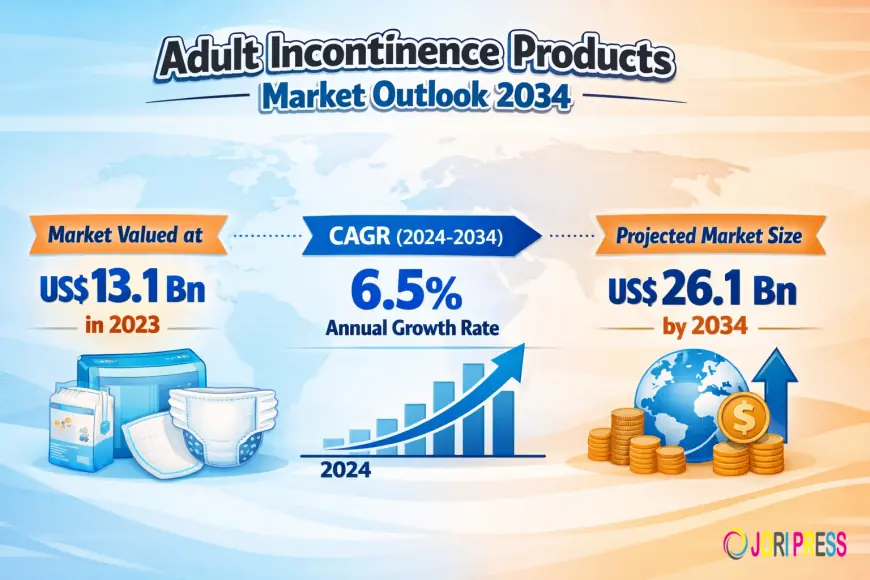
The Adult Incontinence Products Market is witnessing steady and sustained growth globally, driven by demographic shifts, rising awareness about personal hygiene, technological innovation, and increasing prevalence of urinary incontinence. Valued at US$ 13.1 Bn in 2023, the market is projected to expand at a compound annual growth rate (CAGR) of 6.5% from 2024 to 2034, reaching approximately US$ 26.1 Bn by the end of 2034. This growth trajectory reflects a combination of medical, social, and economic factors that are reshaping the global healthcare and personal hygiene landscape.
Understanding Incontinence and Its Growing Impact
Incontinence refers to the involuntary loss of urine or feces due to weakened bladder control or underlying medical conditions. It affects individuals across all age groups but is particularly prevalent among older adults, pregnant women, and patients with chronic health conditions such as diabetes, neurological disorders, prostate issues, and overactive bladder (OAB).
The social stigma historically associated with incontinence has gradually diminished due to awareness campaigns and better education regarding bladder health. As conversations around personal care and health become more open, consumers are increasingly willing to seek appropriate treatment solutions, including specialized incontinence products.
Key Market Drivers
1. Rising Prevalence of Urinary Incontinence
One of the primary factors fueling the expansion of the adult incontinence products market is the increasing incidence of urinary incontinence worldwide. Overactive bladder, stress incontinence, and urge incontinence affect millions globally. Pregnancy, childbirth, pelvic floor trauma, and prostate disorders are among the major contributors to bladder control issues.
As medical diagnoses improve and healthcare access expands, more individuals are identifying symptoms and opting for protective hygiene solutions. This rising patient pool directly translates into growing demand for absorbent and leak-proof incontinence products.
2. Rapid Growth of the Aging Population
The global demographic landscape is shifting dramatically, with populations aging at an unprecedented rate. The proportion of individuals aged 60 years and above is expected to nearly double between 2015 and 2050. In 2022, individuals aged 65 and above accounted for more than 10% of the global population.
Aging is closely associated with physiological changes that weaken bladder muscles and impair neurological responses. Older adults are significantly more susceptible to urinary and fecal incontinence due to chronic diseases, medication side effects, and age-related muscle deterioration.
As the elderly population expands, the need for effective, comfortable, and reliable incontinence management products is becoming increasingly critical. Long-term care facilities, nursing homes, and home healthcare settings are also contributing to heightened product demand.
3. Increased Workforce Participation of Women
Another important driver of market growth is the increasing participation of women in the workforce. Women experiencing mild or moderate incontinence seek discreet and convenient products that allow them to maintain active professional lives without discomfort or embarrassment.
Manufacturers are responding to this demand by designing slim, odor-controlled, and highly absorbent products that resemble regular undergarments. This shift toward discretion and convenience has broadened the consumer base beyond the elderly population to include middle-aged working women.
4. Rising Awareness of Hygiene and Health
Greater emphasis on personal hygiene and preventive healthcare is accelerating adoption of adult incontinence products. Consumers are more informed about health risks associated with poor hygiene, such as skin irritation, infections, and reduced quality of life. Educational initiatives and digital marketing campaigns are playing a crucial role in reducing stigma and encouraging product use.
Product Type Analysis
The adult incontinence products market is segmented into underpads, liners & guards, pull-up underwear, diapers/briefs, and others (including bedding protection products).
Diapers/Briefs: The Dominant Segment
In 2023, the diapers/briefs segment accounted for the largest share of the global market. These products are particularly suitable for individuals with heavy bladder leakage or limited mobility. Their high absorbency levels, odor-control features, and availability in multiple sizes make them a preferred choice for elderly users and patients requiring continuous protection.
Ease of changing and secure fastening systems also contribute to their widespread adoption in healthcare facilities and homecare settings.
Pull-Up Underwear: Fastest Growing Segment
Pull-up underwear is anticipated to witness significant growth during the forecast period. Designed to resemble regular underwear, these products offer enhanced comfort, stretchable waistbands, and improved discretion. They are especially popular among active adults who value convenience and ease of use.
Frequent travelers and working professionals often prefer pull-up underwear due to its practicality and ease of disposal.
Liners & Guards
Liners and guards are primarily used for light to moderate incontinence. Their slim design makes them suitable for individuals seeking minimal bulk and maximum comfort. These products are increasingly being marketed toward younger demographics experiencing occasional leakage.
Underpads and Other Products
Underpads are widely used to protect beds, furniture, and wheelchairs from leakage. They are commonly utilized in hospitals, long-term care facilities, and homecare environments. Bedding protection and specialty absorbent products also contribute to market revenue, particularly in institutional settings.
Disposable vs. Reusable Products
The market is also segmented into disposable and reusable categories.
Disposable Products
Disposable products currently dominate the market due to convenience, hygiene benefits, and ease of use. They are widely available through both online and offline distribution channels and are preferred in medical facilities to minimize infection risk.
Reusable Products
Reusable incontinence products are gaining attention due to increasing environmental awareness and cost-effectiveness over time. These products are washable and designed for long-term use. Growing consumer focus on sustainability is expected to boost demand for reusable options in the coming years.
Absorbency Level Segmentation
Adult incontinence products are categorized into light/moderate, heavy, and overnight absorbency levels.
Heavy and overnight segments are experiencing strong growth, particularly among elderly and immobile patients. Advanced absorbent core technologies and moisture-locking systems are enabling manufacturers to enhance leakage protection while maintaining product comfort.
Distribution Channels
The market is segmented into online and offline distribution channels.
Online Channels
E-commerce platforms and company-owned websites are becoming increasingly important sales channels. Online shopping offers privacy, convenience, subscription services, and home delivery—factors that are particularly appealing for incontinence products.
Digital marketing strategies, customer reviews, and targeted advertising are further driving online sales growth.
Offline Channels
Hypermarkets, supermarkets, drug stores, and other retail outlets continue to play a significant role in product distribution. Physical stores allow customers to examine products and consult pharmacists or healthcare professionals before purchasing.
Regional Outlook
Asia Pacific: Leading Market
Asia Pacific accounted for the largest share of the global adult incontinence products market in 2023. Rapid population aging, particularly in countries such as China and Japan, is a major growth driver. Increasing awareness regarding hygiene and expanding healthcare infrastructure further support market expansion.
Rising disposable incomes and urbanization are also contributing to higher product adoption rates across emerging economies in the region.
North America
North America remains a significant market due to high healthcare awareness, advanced medical infrastructure, and strong presence of leading manufacturers. The region also benefits from supportive reimbursement policies and strong retail networks.
Europe
Europe exhibits steady growth driven by an aging population and well-established healthcare systems. Government initiatives focused on elderly care are enhancing product accessibility.
Middle East & Africa and South America
These regions are gradually expanding due to improving healthcare infrastructure and growing awareness of personal hygiene. Market penetration remains relatively low compared to developed regions, presenting significant growth opportunities.
Competitive Landscape
The adult incontinence products market is highly competitive, with global and regional players investing in product innovation, acquisitions, and strategic partnerships to strengthen their positions.
Prominent manufacturers include Attindas Hygiene Partners Group, Essity AB, First Quality Enterprises, Inc., Hengan International Group Company, Kimberly-Clark Corporation, Medline Industries LP, Ontex BV, Paul Hartmann AG, The Procter & Gamble Company, and Unicharm Corporation.
Innovation and Product Development
Companies are increasingly focusing on advanced absorbent materials, breathable fabrics, skin-friendly designs, and odor-neutralizing technologies. Smart incontinence solutions equipped with moisture sensors and digital monitoring systems are also emerging, enhancing patient care in hospitals and eldercare facilities.
For example, in August 2023, Ontex Group NV introduced Dreamshield and X-CORE technologies to improve discretion and leakage prevention in personal hygiene products. Additionally, Essity AB strengthened its portfolio through acquisition of Modibodi, a company specializing in leak-proof garments.
Emerging Trends
-
Smart Incontinence Products: Integration of sensor-based technologies for real-time moisture detection.
-
Sustainable Solutions: Growing focus on biodegradable materials and reusable products.
-
Premiumization: Increasing demand for ultra-thin, high-performance, and skin-friendly products.
-
Direct-to-Consumer Models: Subscription services and online retail growth.
-
Gender-Specific Products: Tailored designs for men and women.
Future Outlook
The future of the adult incontinence products market appears promising, supported by demographic shifts, technological advancements, and expanding consumer acceptance. As stigma continues to decline and healthcare awareness improves, product penetration is expected to rise across all regions.
Manufacturers that prioritize innovation, sustainability, and consumer-centric design will likely gain competitive advantage. Investment in emerging markets, expansion of distribution networks, and development of eco-friendly materials will further shape industry dynamics.
By 2034, the market is expected to nearly double in value, reflecting both organic growth and strategic industry consolidation.
What's Your Reaction?
 Like
0
Like
0
 Dislike
0
Dislike
0
 Love
0
Love
0
 Funny
0
Funny
0
 Angry
0
Angry
0
 Sad
0
Sad
0
 Wow
0
Wow
0