






































Smart Buildings Cybersecurity Market Size : Industry Analysis, Growth Trends, and Forecast to 2034
Explore the Global Smart Buildings Cybersecurity Market, including growth trends, key drivers, market segmentation, regional insights, and forecast through 2034. According to Dimension Market Research, the market is projected to grow from USD 9.0 billion in 2025 to USD 26.0 billion by 2034 at a CAGR of 12.5%, driven by rising adoption of IoT-enabled buildings, increasing cyber threats, and demand for secure building management systems.
The Global Smart Buildings Cybersecurity Market is emerging as a critical segment within the digital infrastructure and building automation ecosystem. As smart buildings increasingly rely on interconnected systems such as IoT sensors, Building Management Systems (BMS), HVAC controls, surveillance networks, and energy management platforms, the need for robust cybersecurity frameworks has become essential. Smart buildings cybersecurity focuses on protecting these connected environments from cyber threats, unauthorized access, data breaches, and operational disruptions.
With the rapid adoption of smart technologies in commercial real estate, industrial facilities, healthcare buildings, and government infrastructure, the attack surface for cyber threats has expanded significantly. Cybercriminals are increasingly targeting connected building systems due to vulnerabilities in legacy infrastructure, insufficient encryption protocols, and lack of integrated security architectures. As a result, organizations are prioritizing cybersecurity solutions specifically designed for smart building ecosystems.
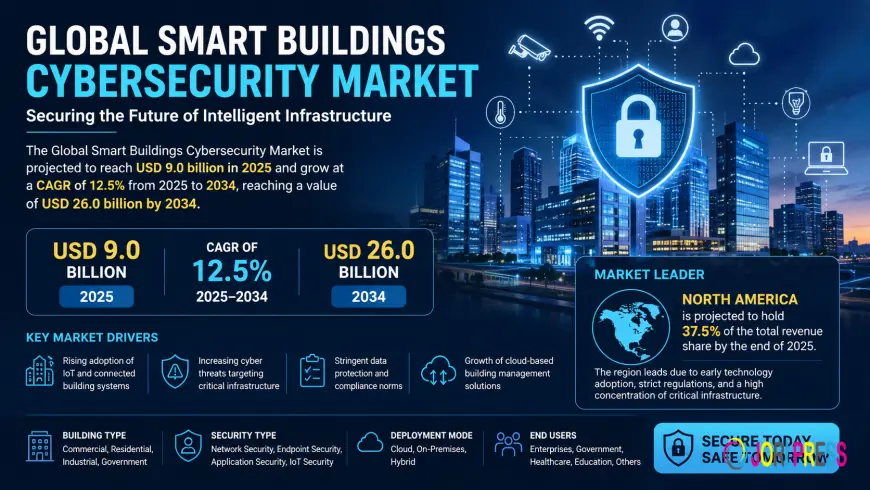
The Global Smart Buildings Cybersecurity Market is projected to reach USD 9.0 billion in 2025 and is expected to grow steadily at a CAGR of 12.5%, reaching approximately USD 26.0 billion by 2034. This strong growth reflects rising awareness of cyber risks in smart infrastructure, increasing regulatory requirements, and growing investment in secure digital building ecosystems.
Understanding Smart Buildings Cybersecurity
Smart buildings cybersecurity refers to the protection of interconnected building systems from cyber threats and digital vulnerabilities. These systems include IoT devices, sensors, surveillance systems, energy management systems, elevators, lighting controls, and cloud-connected building platforms.
Key components include:
- Network security for building automation systems
- IoT device security and authentication
- Cloud security for building management platforms
- Endpoint protection for connected devices
- Access control and identity management
- Threat detection and incident response systems
As buildings become more digitized, cybersecurity is no longer optional but a foundational requirement for safe and efficient operations.
Market Overview
The Smart Buildings Cybersecurity Market is evolving rapidly as digital transformation reshapes the construction and real estate industries. Modern buildings are no longer standalone structures; they are intelligent ecosystems that rely heavily on real-time data exchange and automation.
This increased connectivity has introduced significant cybersecurity risks, making buildings vulnerable to ransomware attacks, unauthorized system access, and data manipulation. As a result, building operators are investing heavily in cybersecurity solutions to safeguard critical infrastructure and ensure operational continuity.
Industries such as commercial real estate, healthcare, education, hospitality, and government facilities are leading adoption due to their high dependency on smart building systems and sensitive operational data.
Key Market Drivers
Rapid Adoption of Smart Building Technologies
The increasing deployment of IoT devices and building automation systems is a major driver of cybersecurity demand. As more systems become interconnected, the need for advanced security frameworks grows exponentially.
Rising Cyber Threats Targeting Infrastructure
Cyberattacks targeting critical infrastructure and building systems are increasing globally. This has led to heightened demand for specialized cybersecurity solutions tailored for smart buildings.
Regulatory Compliance Requirements
Governments and regulatory bodies are implementing stricter cybersecurity standards for critical infrastructure, pushing organizations to adopt secure smart building technologies.
Growth of Cloud-Based Building Management Systems
Cloud integration in building management systems improves efficiency but also increases exposure to cyber risks, driving demand for cloud security solutions.
Emerging Market Trends
Integration of AI in Cybersecurity Systems
Artificial intelligence is being increasingly used to detect anomalies, predict cyber threats, and automate responses in smart building environments.
Zero Trust Security Architecture
Organizations are adopting zero trust models where no device or user is trusted by default, significantly improving building cybersecurity resilience.
Expansion of IoT Security Solutions
With millions of IoT devices deployed in smart buildings, IoT-specific cybersecurity solutions are becoming essential for securing endpoints.
Convergence of IT and OT Security
Operational Technology (OT) and Information Technology (IT) systems are merging in smart buildings, leading to integrated cybersecurity frameworks.
Market Opportunities
Commercial Real Estate Digitization
The rapid digital transformation of commercial buildings is creating significant demand for cybersecurity solutions in real estate management.
Smart City Development Projects
Government-led smart city initiatives are increasing adoption of secure building infrastructure across urban environments.
Healthcare Facility Security
Hospitals and healthcare facilities are investing heavily in smart building cybersecurity due to the sensitivity of patient data and operational systems.
Industrial Smart Infrastructure
Manufacturing plants and industrial facilities are adopting smart systems that require robust cybersecurity protection.
Market Challenges
Legacy Infrastructure Vulnerabilities
Many buildings still rely on outdated systems that are difficult to secure and integrate with modern cybersecurity solutions.
Lack of Standardization
The absence of standardized security protocols for smart buildings creates inconsistencies in implementation.
High Implementation Costs
Deploying advanced cybersecurity solutions across large building networks can be expensive.
Complex System Integration
Integrating cybersecurity across diverse building systems and vendors presents technical challenges.
Market Segmentation
By Component
- Solutions
- Services
- Platforms
By Deployment Mode
- Cloud-Based
- On-Premises
- Hybrid
By Security Type
- Network Security
- Endpoint Security
- Application Security
- Cloud Security
- IoT Security
By Building Type
- Commercial Buildings
- Residential Buildings
- Industrial Facilities
- Government Buildings
- Healthcare Facilities
- Educational Institutions
By End User
- Real Estate Developers
- Facility Management Companies
- Government Agencies
- Enterprises
- Healthcare Providers
Regional Analysis
North America is expected to dominate the Global Smart Buildings Cybersecurity Market, accounting for approximately 37.5% of total revenue by 2025. The region’s leadership is driven by early adoption of smart building technologies, strong regulatory frameworks, and high awareness of cybersecurity risks.
The United States, in particular, has a highly advanced commercial real estate sector that has widely implemented IoT-based building management systems. This extensive digital infrastructure creates a large installed base requiring continuous cybersecurity protection.
Additionally, strict cybersecurity regulations and the presence of major technology providers further strengthen regional dominance. Organizations across North America are increasingly investing in AI-driven cybersecurity systems and zero-trust architectures to protect smart building ecosystems from evolving cyber threats.
Competitive Landscape
The Smart Buildings Cybersecurity Market is highly competitive, with companies focusing on innovation, AI integration, and advanced threat protection capabilities.
Key competitive strategies include:
- Development of AI-powered threat detection systems
- Expansion of IoT security platforms
- Zero trust architecture implementation
- Cloud-native cybersecurity solutions
- Real-time monitoring and analytics tools
- Integration with building management systems
- Automated incident response systems
- Strategic partnerships with real estate developers
- Advanced encryption and access control systems
- Managed security service offerings
Continuous innovation is essential as cyber threats targeting smart infrastructure continue to evolve.
Future Outlook
The future of the Smart Buildings Cybersecurity Market is highly promising, driven by increasing digitalization of infrastructure and rising cybersecurity threats.
Key growth drivers include:
- Expansion of smart building ecosystems
- Growth of IoT and connected devices
- Increasing adoption of AI-driven security
- Rising smart city investments
- Strong regulatory enforcement
- Integration of IT and OT security systems
As buildings become more intelligent and interconnected, cybersecurity will become a foundational pillar of building design and operation.
Frequently Asked Questions
1. What is the Smart Buildings Cybersecurity Market?
It refers to cybersecurity solutions designed to protect connected building systems such as IoT devices, building automation systems, and smart infrastructure from cyber threats.
2. What is driving market growth?
Growth is driven by increasing adoption of smart building technologies, rising cyber threats, regulatory compliance requirements, and IoT expansion.
3. Which industries use smart building cybersecurity solutions?
Key industries include commercial real estate, healthcare, government, education, hospitality, and industrial facilities.
4. What is the market size outlook?
The market is projected to reach USD 9.0 billion in 2025 and grow to USD 26.0 billion by 2034, at a CAGR of 12.5%.
5. Why is North America leading the market?
North America leads due to early smart building adoption, strong cybersecurity regulations, advanced infrastructure, and high investment in digital security solutions.
Summary of Key Insights
The Smart Buildings Cybersecurity Market is experiencing strong growth as buildings become increasingly connected and digitally driven. With projected expansion from USD 9.0 billion in 2025 to USD 26.0 billion by 2034, the market is driven by IoT adoption, cyber threat escalation, and regulatory compliance requirements. North America remains the dominant region due to its advanced infrastructure and early adoption of smart building technologies. As smart infrastructure continues to expand globally, cybersecurity will play a critical role in ensuring safe, efficient, and resilient building operations.
What's Your Reaction?
 Like
0
Like
0
 Dislike
0
Dislike
0
 Love
0
Love
0
 Funny
0
Funny
0
 Angry
0
Angry
0
 Sad
0
Sad
0
 Wow
0
Wow
0