

































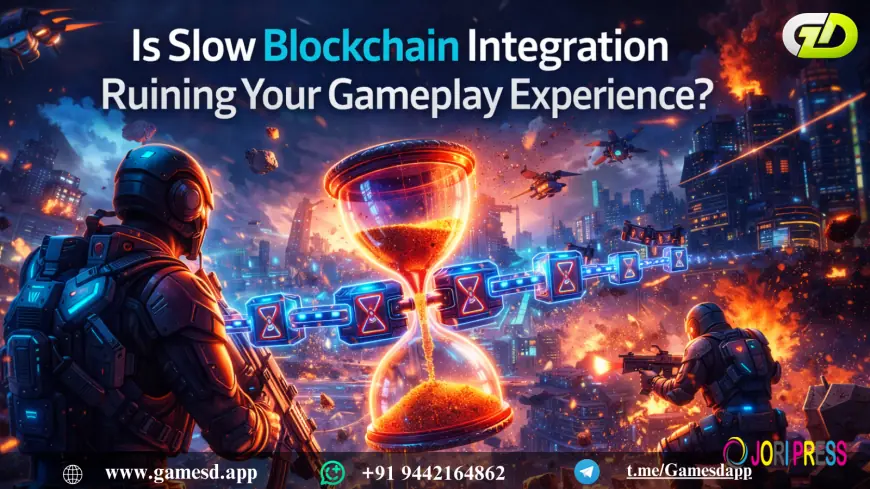
Is Slow Blockchain Integration Ruining Your Gameplay Experience?
The most successful P2E games will be the ones that combine speed, scalability, and seamless integration—where blockchain works quietly in the background while gameplay remains fluid and engaging.

Play-to-Earn games promised ownership, transparency, and real rewards. But somewhere along the way, many projects overlooked one fundamental principle of gaming:
Gameplay must always feel instant.
Players expect actions to register immediately—attacks, trades, upgrades, and rewards. When blockchain integration introduces delays, confirmations, or gas fee interruptions, the experience stops feeling like a game and starts feeling like a transaction dashboard.
And that’s where most P2E platforms quietly lose their audience.
Because in gaming, even a two-second delay is too long.
The Speed Problem Players Won’t Tolerate
Traditional games are built for responsiveness. Tap, move, shoot, collect—everything happens in real time. That instant feedback loop is what makes gameplay addictive and immersive.
Now compare that to many blockchain-powered games.
A player wins a battle but waits for transaction confirmation. They try to claim rewards but face network congestion. They attempt to trade assets but pay unexpected gas fees.
These interruptions break flow. Instead of excitement, players feel friction. Instead of fun, they feel frustration.
And once gameplay feels slow, users simply leave—often permanently.
Where Blockchain Integration Goes Wrong
The issue isn’t blockchain itself. It’s poor implementation.
Many projects push every action on-chain, assuming decentralization must handle everything. The result? Overloaded networks, higher costs, and delayed interactions. Critical gameplay elements that should be instant become dependent on external confirmations.
This is where experienced Blockchain game development practices matter. Smart architecture separates what must be on-chain (ownership, rewards, transactions) from what should remain off-chain (core gameplay mechanics). By balancing both layers, developers preserve security without sacrificing speed.
In other words, blockchain should support the game—not slow it down.
Designing Games First, Technology Second
One of the most common mistakes in P2E is prioritizing token systems over player experience. Teams often design around wallets, smart contracts, and rewards before ensuring the game itself is enjoyable.
But players don’t join for infrastructure. They join for entertainment.
Studios that succeed treat gameplay as the foundation and integrate blockchain only where it adds real value. A specialized P2E Game Development Company understands this balance—building fast, scalable backends while carefully embedding Web3 mechanics in ways that feel seamless rather than intrusive.
When technology becomes invisible, immersion improves. And that’s exactly the goal.
Immersion Demands Performance
Modern players expect rich environments, smooth animations, and interactive worlds. Visual fidelity and responsiveness now define quality.
This is especially true as experiences evolve with 3D Game Development, where real-time rendering, physics, and multiplayer synchronization require high performance. Adding slow transaction layers on top of these systems creates a mismatch. Stunning visuals lose impact if every reward or upgrade is delayed by seconds.
Performance is no longer optional—it’s directly tied to retention.
If the world feels alive but the economy feels slow, the illusion collapses.
The Bottom Line
Blockchain technology has enormous potential to transform gaming — true ownership, tradable assets, and decentralized economies are powerful advantages. But none of it matters if the core experience feels sluggish.
Players don’t measure block confirmations. They measure fun.
The most successful P2E games will be the ones that combine speed, scalability, and seamless integration—where blockchain works quietly in the background while gameplay remains fluid and engaging.
Because at the end of the day, players stay for great games—not waiting screens.
For More details,
+91 9442164862
What's Your Reaction?
 Like
0
Like
0
 Dislike
0
Dislike
0
 Love
0
Love
0
 Funny
0
Funny
0
 Angry
0
Angry
0
 Sad
0
Sad
0
 Wow
0
Wow
0