


































How Do You Develop an Android App?
This guide explains how to plan, design, build, test and scale an Android app in 2026. It covers tools, coding practices, security, monetization, statistics and expert insights to help businesses launch reliable and scalable Android applications.
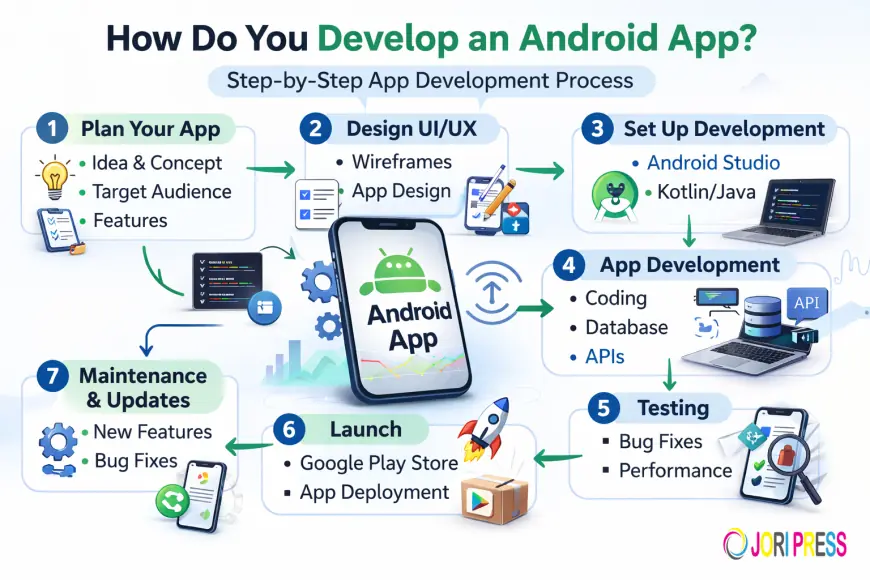
Android remains the dominant mobile operating system. Businesses, those dealing with things such as money, well-being, retail, education, and software provision, require Android applications in order to reach a huge customer base.
Even though there is still plenty of competition in 2026, there is more chance for success.
Forbes says that over fifty percent of all time spent on digital media is on mobile devices – so it makes sense that companies put mobile first in their plans.
Entrepreneur points out those new companies which start digital items using mobile systems can prove what will work more quickly and lower the possibility of failing in the market.
Inc. states that companies building scalable digital products see stronger recurring revenue compared to traditional service models.
These numbers show one clear fact.
Apps for mobiles are what makes businesses expand. Billions of active people across the globe can be contacted via Android.This handbook outlines the complete, technical process of Android app building in 2026, in a way that is both easy to understand and helpful.
Define the Problem Before Writing Code
Every successful app starts with a clearly defined problem. Do not begin with features. Begin with user pain points.
Identify your target audience. Study their behaviour. Understand their daily challenges. Conduct interviews. Run small surveys. Validate demand before investing in development.
When founders search How to create an app for Android, they often think about coding first. In reality, product clarity matters more than programming language.
Create a value proposition. Define how your app solves a specific problem better than existing solutions. Clear positioning reduces failure risk.
Conduct Market and Competitive Analysis
Open the Google Play Store and analyse top performing apps in your niche. Study there:
- User ratings
- Customer reviews
- Feature lists
- Pricing structure
- Update frequency
Read negative reviews carefully. Users openly share what frustrates them. You can use those insights to design better user flows.
Forbes emphasizes that data driven decisions increase product success rates and reduce business uncertainty.
Do not guess. Use research to guide strategy.
Choose the Right Technology Stack
In 2026 Android application creation provides a choice of platforms and instruments amongst Kotlin, Java, Flutter and React Native.
Google backs Kotlin very firmly as the best language for Android apps which are native.It has got neater wording and is more secure.
Should you require complete system access and maximum speed, pick native development, although Flutter or React Native would be the ones to go for if you’re after cross platform quickness.
Many beginners ask How do you develop an android app from scratch without technical background. The answer remains structured learning, correct tools and strong architecture planning.
Avoid overcomplicating the stack. Choose technology that matches your business goal and scalability plan.
Set Up Android Studio Environment
Android Studio remains the official development environment for Android apps. It provides everything required for professional development.
Developers frequently search Android Studio download when they begin their journey. After installing the IDE, configure SDK tools and emulators properly.
Begin a fresh project. Be thoughtful when you choose the lowest SDK version.Going lower gets your app onto more devices, but newer versions let you use the best, most up-to-date functions. The collection of Android Studio apps is always getting better.
In 2026, expect even more useful debugging tools, ways to check performance, and quicker emulators. Starting with a neat arrangement will stop you running into problems with the technology later on.
Design User Experience with Simplicity
Users decide within seconds whether they keep or uninstall your app. Design influences retention.
Focus on clarity. Use readable fonts. Maintain consistent spacing. Avoid clutter. Follow Material Design principles.
According to Entrepreneur, a good user experience really boosts how long customers stay with, and use, digital products.
Create wireframes before writing code. Validate user flows. Conduct small usability tests. Good design reduces future rework.
Core Development Process
Development begins after validation and design approval. Structure your code properly from day one.
It is good to have design standards. Separate what the user sees from the stuff that makes it work, andthe information it uses.
Code broken into parts like this is easier to keep up with. If you have not done much coding before, maybe start with a basic application using Android Studio and Java, to get the hang of how activities run, how to set up displays and how to respond to what the user does.
Start with:
- User authentication
- Core feature implementation
- Database integration
- API connection
- Error handling
People who start a company and then wonder how to build an Android app, usually want a quick way to do it, but a quick way is not available. Development which is organised, however, guarantees the app will work well for years to come.
Write readable code. Avoid unnecessary complexity. Test frequently during development.
Essential Technical Practices in 2026
- Use Jetpack libraries for lifecycle management and navigation
- Implement MVVM architecture for scalability
- Integrate secure APIs with HTTPS protocols
- Use cloud backend solutions for storage and synchronization
- Monitor performance through profiling tools
- Automate builds using CI CD pipelines
- Maintain version control with Git
These things make the app more dependable and allow for quicker releases of new versions. Today, making Android apps well requires proper, disciplined, technical skills.
Testing and Quality Assurance
Testing protects brand credibility. Users uninstall unstable apps immediately.
Test on multiple Android versions. Test on different screen sizes. Simulate slow networks. Monitor battery usage. Check memory consumption.
Inc. explains that companies launching minimum viable products with continuous iteration reduce product failure rates significantly.
Conduct both manual and automated testing. Fix bugs before public release. Quality builds trust.
Security and Data Protection
Security remains critical in 2026. Data breaches damage reputation permanently.
Implement encrypted local storage. Secure authentication flows. Restrict unnecessary permissions. Use secure backend connections.
Forbes points out that, as more and more businesses go digital, keeping things secure is still one of the most important things for companies around the world.
Protect user data proactively. Compliance builds credibility.
App Store Publishing and Optimization
Prepare clear screenshots. Write benefit driven descriptions. Include privacy policy links. Create a compelling app icon.
When developers wonder How to make an app visible in competitive categories, optimization becomes essential.
Use relevant keywords naturally. Highlight key benefits in the first few lines. Encourage satisfied users to leave reviews.
App Store Optimization increases organic visibility and long-term downloads.
Monetization Strategy
Choose monetization based on audience behaviour. Options include subscription, in app purchases, advertisements and freemium access.
Inc. reports that subscription based digital models provide predictable recurring revenue streams for modern businesses.
Align revenue model with user expectations. Do not overload with ads if user experience suffers.
Post Launch Growth and Analytics
Launching the app marks the beginning, not the end. Track user metrics actively.
Measure daily active users. Monitor retention rate. Study churn patterns. Analyze session duration.
Entrepreneur also makes the point that what makes digital products do well, versus not, is constantly working on them, putting out new versions often, making them run better, and including things people want, depending on how users actually behave.
Cost Considerations in 2026
How much an app costs to build are affected by how complicated the features are, what systems are on the back end, how much detail goes into the user interface and what level of security is needed. Forbes has pointed out that companies are still raising the amount of money they put into digital things, because mobile tech gives companies an edge over others.
Treat Android development as long-term investment. Cheap shortcuts create future losses.
Choosing a Development Partner
Not every founder has technical expertise. In such cases, partnering with experienced teams becomes practical.
Look at how technically skilled people are, the quality of work they have done before, how well they can explain what they are doing. And even what kind of help they offer after the app is out.
Companies such as Originate Soft help businesses with well-planned Android app building, systems that can handle more users. Technical plans aimed at helping the business to get bigger, and all while keeping things professional.
Choose partners who focus on engineering discipline and user value.
Future Trends in Android Development
By 2026, creating Android apps will involve AI, speech-based controls, links to devices people wear, and getting things to work alongside the Internet of Things.
While programmers will have AI helping them find mistakes and guess what users will do, people will still be in charge of how apps are built and what users feel when using them.
It is important to know what Google wants developers to do, and to keep on learning, that is how you will do well against other developers.
Final Thoughts
In 2026, making Android apps will demand being clear, doing your homework, having good technical skill, and always putting users first.
Begin with validated problems. Choose the correct technology stack. Design intuitive interfaces. Write structured code. Test rigorously. Protect user data. Optimize store presence. Track analytics after launch.
If you go through a sensible, organised method like that, you lower the chances of things going wrong, and make it easier to grow. Figures from Forbes, Entrepreneur, and Inc. all plainly show that companies using mobile are still getting ahead of those that donot.
Android is still a very good place to grow a digital business. Getting things right is what matters, not just having a good thought.
What's Your Reaction?
 Like
0
Like
0
 Dislike
0
Dislike
0
 Love
0
Love
0
 Funny
0
Funny
0
 Angry
0
Angry
0
 Sad
0
Sad
0
 Wow
0
Wow
0