








































The Rise of Middle Eastern Cooking in New York Restaurants
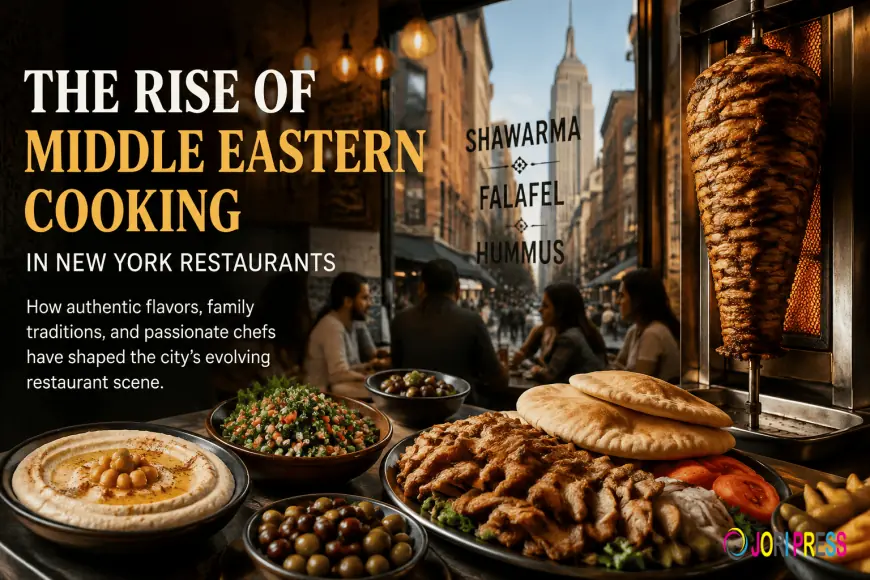
Middle Eastern cuisine has become an essential part of New York's dining culture. Explore how authentic flavors, family traditions, and passionate chefs have shaped the city's evolving restaurant scene.
New Yorkers can never seem to agree on much when it comes to food.
Ask ten people where to find the city's best pizza, and one will tell you an entirely different place than the other. The same goes for bagels, cheesecake, pastrami, ramen, and shawarma etc. One can never seem to find agreement on what is objectively the best, and where it is located.
It seems as though the same kind of debate has erupted on shawarma.
This dish, which has been in the home kitchens of Middle Eastern New Yorkers for years, has acquired an immense following in recent times.
So much so that some Middle Eastern
restaurants' lunch rushes consist of a construction worker and a lawyer both ordering the same dish.
restaurants' lunch rushes consist of a construction worker and a lawyer both ordering the same dish.
A tourist could be seen perusing the menu while the regular gets seconds of toum sent to his table.
A mob of people flooded the dining room upon their arrival, and another plate of falafel was gone in minutes, the fresh pita never leaving their hands for long.
It is hard to believe that this could all be the result of some pre-planned marketing scheme, an orchestrated master plan by Middle Eastern restaurant owners to capitalize on their product, but it feels as though it has come about organically, as the natural result of a dish being integrated into the city's food ecosystem.
It could have begun with a single foodie who flocked to a specific shawarma spot, or a couple of families who took their friends to a Middle Eastern restaurant for dinner, or even just the subtle hints at the quality of the freshly baked pita that have been dropped by some of its biggest fans.
Whatever the reason, Middle Eastern cuisine has managed to make itself at home in the city.
The New York area has always been fertile ground for this particular type of restaurant, as the establishments that have managed to thrive for decades are usually family owned and operated, catering to the expectations of regulars who know what they want and expect nothing less.
Most Middle Eastern restaurants that have endured the test of time have done so by sticking to their tried and true recipes without altering them, rather than attempting to reshape themselves in the image of whatever the food world wants at the moment.
The lentils are still soaked for hours and formed into falafel, the meat is still marinated in the same mix of flavors before being slowly cooked on a rotisserie, and the pita is still fresh every day, for yesterday's simply won't do.
It is this kind of uncompromising work ethic that is found in very few other places in the city.
If one were to visit one of the busier Middle Eastern restaurants a few hours before their opening time, they would notice that the floors are bare and empty save for the people who are there to prepare the food.
There maybe someone dicing fresh parsley or mixing up the garlic sauce, but other than that everything seems pretty quiet.
The only sounds to be heard are the sizzling meats that are slowly prepared to be wrapped in pita pockets and filled with warm falafel, the dough being rolled out and folded into triangles that will soon be filled with these very same dishes, and the baba ghanoush waiting to be scooped out of its roasted skin.
It can seem as though all of this effort is wasted on nothing, as the restaurant is still virtually empty and the large amounts of food being prepared will surely go to waste, but this is simply not the case.
People who visit the restaurant again and again simply love the food that they ordered before, even if it takes considerable time to prepare.
Repeat customers always seem to appreciate this kind of dedication, especially in an age when everyone and their mother is a social media influencer with a critical eye for food that looks good in pictures more than anything else.
In this way, it seems as though word of mouth has a much bigger impact on the local Middle Eastern food scene than anything else.
Shawarma and falafel are not the only Middle Eastern dishes that have seen their popularity rise in recent years either, as it seems as though their popularity has been steadily climbing for a number of years.
Restaurants have responded to this increased interest by updating their menus to include a larger variety of dishes that fall under the Middle Eastern umbrella.
People who visit these restaurants are looking to try manakish, baba ghanoush, muhammara, lamb, kofta, musakhan, and knafeh; they are looking for something different, and the Middle East seems to deliver on that front in spades.
The increased interest in Middle Eastern food in general has also spurred more inquisitive customers to seek it out, who may not have been as interested before, and the restaurants are responding by featuring a greater variety of traditional dishes than ever before.
While it is true that social media has provided a great boost to the popularity of these kinds of restaurants, pictures simply do not tell the whole story.
The shawarma that looks good on your friend's Instagram may entice you to visit the neighborhood spot on Sunday, but it is the food itself that will keep you coming back for lunch on Monday.
Word of mouth may have helped these kinds of restaurants gain popularity, but the viral image that gets millions of likes will simply get them noticed.
As said before, it can be difficult to tell what, if anything, actually caused the Middle Eastern restaurant boom to begin with.
It could have begun with a single foodie who flocked to a specific shawarma spot, or a couple of families that took their friends to a Middle Eastern restaurant, but whatever the reason, it seems as though middle eastern food has made itself right at home in the city.
This kind of success could never have been attained without the efforts of everyone who took part in this endeavor, from the home cooks who prepared these meals all the way to the people who run their neighborhood shawarma spot.
It is hard to believe how far this kind of dedication has taken this particular type of food, but every effort has paid off with this unique dish becoming a staple in the local city food scene.
After all, food is usually the easiest way for people to experience another culture.
Every neighborhood has its own unique charm that comes from the people who built their homes there, and every restaurant has its own tale to tell, but the Middle Eastern cultural landscape is one such story that has been told and retold countless times.
The next time you pass by a crowded shawarma stand or catch the scent of freshly baked pita, it is unlikely to strike you as anything out of the ordinary.
That is because Middle Eastern food is no longer something that is simply found in this city;8 it is a part of it.
What's Your Reaction?
 Like
0
Like
0
 Dislike
0
Dislike
0
 Love
0
Love
0
 Funny
0
Funny
0
 Angry
0
Angry
0
 Sad
0
Sad
0
 Wow
0
Wow
0

chrissalman
Love food and travel
\