


































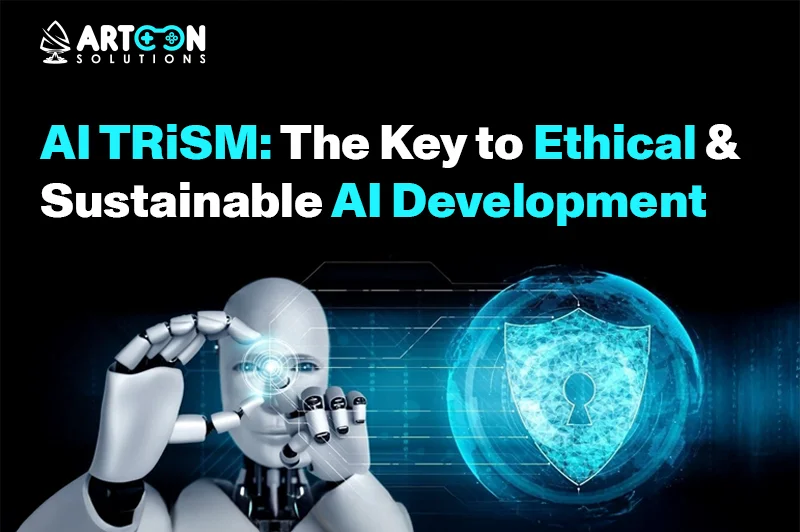
AI TRiSM: The Key to Ethical and Sustainable AI Development
Learn what AI TRiSM is, why it matters, and how businesses build ethical, secure, and sustainable AI systems with governance, trust, and risk controls Today!

Artificial intelligence is now embedded in the core of modern businesses, powering customer experiences, automating decisions, and influencing outcomes at an unprecedented scale. But as AI adoption accelerates, so do the risks. Biased algorithms, opaque decision-making, data privacy breaches, and regulatory non-compliance are no longer theoretical concerns; they are real business threats. This is where AI TRiSM becomes essential.
AI TRiSM (AI Trust, Risk, and Security Management) is a structured approach to ensuring AI systems are ethical, transparent, secure, and sustainable throughout their lifecycle. In 2026, organizations can no longer afford to “build first and fix later.” Regulators, customers, and stakeholders expect responsible AI by design.
For founders, CTOs, product managers, and enterprise decision-makers in the USA, AI TRiSM is not just a governance framework; it’s a strategic enabler. It helps organizations deploy AI faster and safer, reduce legal and reputational risk, and build long-term trust with users and partners.
This comprehensive guide explains what AI TRiSM is, why it matters, its core pillars, real-world use cases, implementation best practices, and how businesses can operationalize AI trust at scale, often with the support of an AI app development company or artificial intelligence development services.
What Is AI TRiSM?
AI TRiSM stands for AI Trust, Risk, and Security Management. It is a comprehensive framework designed to manage the ethical, operational, legal, and security risks associated with AI systems.
In simple terms:
AI TRiSM ensures AI systems are trustworthy, compliant, explainable, and secure from development through deployment and beyond.
Why AI TRiSM Exists
Traditional IT governance frameworks were not built to handle:
-
Self-learning models
-
Probabilistic outcomes
-
Opaque (“black box”) decisions
-
Rapid model drift
AI TRiSM fills this gap by addressing the unique challenges of modern AI.
The Three Pillars of AI TRiSM
AI TRiSM is built on three interconnected pillars: Trust, Risk, and Security.
1. Trust: Building Confidence in AI Systems
Trust is the foundation of AI adoption. Without it, users resist, and regulators intervene.
Key Trust Components
-
Transparency: Clear documentation of data sources, models, and decisions
-
Explainability: The ability to explain why an AI made a decision
-
Fairness: Mitigation of bias across protected attributes
-
Accountability: Clear ownership and escalation paths
Practical Trust Measures
-
Model cards and datasheets
-
Explainable AI (XAI) techniques
-
Bias audits and fairness metrics
-
Human-in-the-loop reviews
Trust enables faster adoption and sustained use, especially in customer-facing AI.
2. Risk: Identifying and Managing AI Risks
AI introduces new categories of risk that must be continuously assessed.
Common AI Risks
-
Model drift: Performance degradation over time
-
Bias amplification: Unintended discrimination
-
Hallucinations: Confident but incorrect outputs
-
Regulatory non-compliance: Violations of AI laws
-
Operational failures: Downtime or incorrect automation
Risk Management Practices
-
Continuous monitoring and retraining
-
Pre-deployment risk assessments
-
Scenario testing and stress tests
-
Impact assessments
Effective AI trust management treats risk as a living process, not a one-time checklist.
3. Security: Protecting AI Systems End-to-End
AI systems expand the attack surface. Security must extend beyond infrastructure.
AI-Specific Security Threats
-
Data poisoning
-
Model inversion and extraction
-
Prompt injection
-
Adversarial attacks
-
Supply chain vulnerabilities
Security Controls for AI
-
Secure data pipelines
-
Model access controls
-
Encryption at rest and in transit
-
Continuous threat detection
-
Secure deployment (MLOps security)
Security ensures AI remains reliable and safe even under attack.
Why AI TRiSM Is Critical in 2026
Several forces are driving the rapid adoption of AI TRiSM.
Key Drivers
-
Expanding AI regulations (US state laws, sectoral rules)
-
Increased scrutiny from customers and the media
-
Higher financial penalties for non-compliance
-
Growing reliance on AI for critical decisions
-
Enterprise-scale AI deployments
Organizations that invest early in AI TRiSM gain a competitive advantage by reducing friction and accelerating responsible innovation.
AI TRiSM Across the AI Lifecycle
AI TRiSM is not a single tool; it’s a lifecycle approach.
1. Design & Data
-
Ethical data sourcing
-
Consent and privacy checks
-
Bias risk identification
2. Development & Training
-
Secure training environments
-
Explainability built-in
-
Fairness testing
3. Deployment
-
Access controls
-
Model monitoring
-
Performance benchmarks
4. Operations & Monitoring
-
Drift detection
-
Incident response
-
Continuous compliance
5. Retirement
-
Safe decommissioning
-
Data and model cleanup
Real-World Use Cases of AI TRiSM
Financial Services
-
Explainable credit decisions
-
Fraud detection with bias controls
-
Regulatory reporting automation
Healthcare
-
Transparent diagnostics
-
Patient data protection
-
Clinical decision accountability
Human Resources
-
Fair hiring algorithms
-
Bias audits for screening tools
-
Explainable candidate ranking
Retail & E-commerce
-
Transparent recommendations
-
Secure personalization
-
Ethical pricing models
Enterprise AI Platforms
-
Model governance at scale
-
Multi-tenant security
-
Audit-ready deployments
Benefits of Implementing AI TRiSM
AI TRiSM delivers tangible business value.
Key Benefits
-
Reduced legal and compliance risk
-
Faster AI deployment approvals
-
Higher user trust and adoption
-
Improved model reliability
-
Better alignment with corporate values
-
Stronger brand reputation
For scaling organizations, these benefits directly impact growth and resilience.
Common Challenges in AI TRiSM Adoption
Despite its value, AI TRiSM adoption can be challenging.
Typical Obstacles
-
Lack of AI governance expertise
-
Tooling fragmentation
-
Cultural resistance
-
Cost concerns
-
Legacy system integration
Many organizations overcome these challenges by partnering with artificial intelligence app development services that embed AI TRiSM by design.
Best Practices for Implementing AI TRiSM
Step-by-Step Approach
-
Define AI principles aligned with business values
-
Map AI risks across use cases
-
Select governance tooling (monitoring, XAI, security)
-
Embed controls into MLOps
-
Train teams on responsible AI
-
Audit and improve continuously
Organizations often work with an AI app development company to operationalize these practices at scale.
Build vs Buy: AI TRiSM Solutions
Off-the-Shelf Platforms
-
Faster to deploy
-
Limited customization
Custom AI TRiSM Frameworks
-
Tailored controls
-
Deeper integration
-
Competitive differentiation
Custom approaches often require teams to hire AI developers with experience in governance, security, and MLOps.
The Future of AI TRiSM
AI TRiSM will continue to evolve alongside AI capabilities.
What’s Next
-
Automated compliance checks
-
Continuous ethical monitoring
-
AI agents with built-in governance
-
Cross-border AI compliance frameworks
-
Trust scoring for AI systems
In the future, AI TRiSM won’t slow innovation; it will enable it.
Conclusion
AI TRiSM is no longer optional; it is the foundation for ethical, secure, and sustainable AI development. As AI systems influence more decisions and outcomes, organizations must ensure trust, manage risk proactively, and secure models across their lifecycle. AI TRiSM provides the structure to do exactly that.
For founders, CTOs, and enterprise leaders, adopting AI TRiSM means moving faster with confidence. It reduces regulatory exposure, strengthens customer trust, and enables scalable AI innovation without compromising values or safety.
Whether you’re launching your first AI product or scaling enterprise-wide deployments, success depends on embedding AI TRiSM from day one. Many organizations accelerate this journey by partnering with an AI app development company, leveraging artificial intelligence development services, or choosing to hire AI developers skilled in governance and security.
Planning a responsible AI initiative?
Use our AI Cost Calculator to estimate development costs, timelines, and ROI, and build AI systems that are not just powerful, but trusted and future-ready.
What's Your Reaction?
 Like
0
Like
0
 Dislike
0
Dislike
0
 Love
0
Love
0
 Funny
0
Funny
0
 Angry
0
Angry
0
 Sad
0
Sad
0
 Wow
0
Wow
0